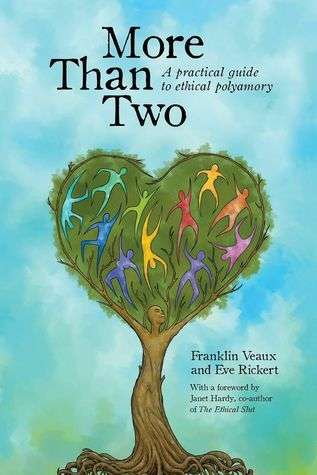
More Than Two: A Practical Guide to Ethical Polyamory
You’ve Probably Already Heard of This Book
If you’ve spent any time in polyamory circles, someone has handed you a copy of More Than Two: A Practical Guide to Ethical Polyamory. For years, it was the book, the one people pressed into their partner’s hands when the “I think I might be polyamorous” conversation started. Written by Franklin Veaux and Eve Rickert and published in 2014 by Thorntree Press, it built on Veaux’s popular morethantwo.com website and quickly became the most widely recommended resource on ethical non-monogamy. Veaux had been writing about polyamory online for over a decade, and Rickert brought editorial rigor and her own relationship experience to the project. At 480 pages, it covered everything from jealousy management to relationship structures to a “Relationship Bill of Rights” that became widely quoted in ENM communities. It won a Foreword INDIES Book of the Year Award. It was the gold standard.
And then everything changed.
The Controversy You Need to Know About
There’s no responsible way to review this book without talking about what came to light in 2019. Seven of Franklin Veaux’s former partners, including Eve Rickert herself, came forward publicly with accounts of emotional abuse, coercion, and manipulation that directly contradicted the ethical framework Veaux had built his reputation on.
The accounts were detailed and consistent. Former nesting partners described verbal abuse, gaslighting, and patterns of control. Two of them, over a decade apart, fled the homes they shared with him. The survivors described lasting effects: self-doubt, difficulty trusting others, suicidal ideation, and years of recovery. Dr. Elisabeth Sheff, a sociologist who studies polyamory, published an independent analysis of the survivor narratives and found them credible and consistent with established patterns of intimate partner abuse.
Rickert herself published a re-analysis of parts of More Than Two, explaining how some of the book’s core ideas grew directly out of the dysfunctional dynamics of her relationship with Veaux. As she put it, the toolkit the book offered was “incomplete, and very heavily skewed toward a certain dynamic — our dynamic. Which became abusive.”
This matters because the book’s central argument is about ethics and consent in relationships. When the person making that argument is credibly accused of violating those same principles with multiple partners, it changes how you read every page. It doesn’t erase every useful idea in the book, but it means you can’t pick it up without that context.
What the First Edition Actually Argues
The book’s framework centers individual autonomy as the foundation of ethical polyamory. It argues that each person in a relationship network is responsible for their own emotions, that rules imposed on partners are inherently suspect, and that the path to healthy polyamory runs through radical self-ownership.
There’s real value in some of this. The sections on examining jealousy, what it’s actually telling you, how to sit with it rather than demand your partner fix it, are genuinely useful for people doing the hard work of polyamorous and non-monogamous therapy. The Relationship Bill of Rights offers a framework for thinking about what you deserve in any relationship. The book treats non-monogamy as a legitimate relationship orientation rather than something that needs defending, which was more radical in 2014 than it sounds now.
But the autonomy framework has a blind spot that, in retrospect, looks a lot like the blind spot in Veaux’s own relationships. When “your feelings are your responsibility” gets pushed too far, it becomes a tool for dismissing a partner’s pain. When “no one is entitled to rules” gets applied without nuance, it can strip away the boundaries that keep people safe. The book doesn’t spend enough time on accountability, on what you owe the people you’re in relationships with, on the difference between autonomy and indifference.
Where It Falls Short (Even Without the Controversy)
Set the author controversy aside entirely, and the first edition still has problems worth naming.
The book is written from a white, middle-class, largely heteronormative perspective that gets presented as universal. It doesn’t meaningfully engage with how race, class, disability, or immigration status shape the risks and realities of practicing polyamory. For clients exploring ENM through queer-affirming therapy, the gaps in intersectional awareness are real.
The jealousy framework is optimistic to the point of being misleading. Jealousy shows up in the book as something you can reason through with enough self-awareness and communication. In practice, jealousy is often rooted in attachment patterns, childhood wounds, or trauma responses that need more than good conversation to work through. People who read this book and still struggle with jealousy sometimes end up feeling like they’re failing at polyamory, when really the book just undersold how hard the emotional work actually is.
There’s also very little trauma awareness. For anyone with a history of relationship abuse, sexual trauma, or abandonment, the book’s emphasis on pushing through discomfort and questioning your own boundaries can be actively harmful.
The Second Edition: A Different Book
In 2024, Eve Rickert acquired the rights to More Than Two and published a substantially revised second edition with co-author Andrea Zanin. The new subtitle tells you something: Cultivating Nonmonogamous Relationships with Kindness and Integrity.
Rickert and Zanin rewrote the book to balance autonomy with accountability. They address the harm the first edition caused, update the language around gender and identity, pare back the personal disclosures that were shaped by Veaux’s influence, and center a more trauma-informed approach. Kirkus called it “a smart, compassionate resource.” If you’re going to read More Than Two at all, the second edition is the one to pick up.
Who This Book Is (and Isn’t) For
If you’re exploring ethical non-monogamy, you’ll probably encounter the first edition whether you seek it out or not. Reading it with full knowledge of the controversy can actually be instructive. You can see where good ideas get weaponized, where an emphasis on individual freedom tips into something that enables harm.
But if you’re looking for a practical guide to actually building healthy non-monogamous relationships, the second edition or other books will serve you better. And if you’re working through jealousy, communication breakdowns, or the gap between what polyamory looks like in theory versus how it feels in practice, couples therapy with someone who has lived experience in ENM communities is worth more than any book.
Further Reading
If More Than Two is on your list (or already on your shelf), these books fill in the gaps and offer frameworks the first edition was missing:
Polysecure by Jessica Fern brings attachment theory into non-monogamy in a way that gives you real tools for understanding why jealousy and insecurity hit the way they do. It’s probably the single best companion piece to More Than Two.
The Ethical Slut by Dossie Easton and Janet Hardy is the other foundational polyamory text. It’s got its own limitations, but it comes from a different place and offers a different lens.
Opening Up by Tristan Taormino takes a more journalistic, research-based approach and includes a wider range of relationship structures and voices than either More Than Two or The Ethical Slut.
Polywise by Jessica Fern and David Cooley is a deeper dive into the practical and emotional challenges that come up once you’re actually living non-monogamy, not just reading about it.
Building Open Relationships by Dr. Liz Powell offers an updated, inclusive workbook-style approach that’s particularly strong on communication skills and self-reflection exercises.