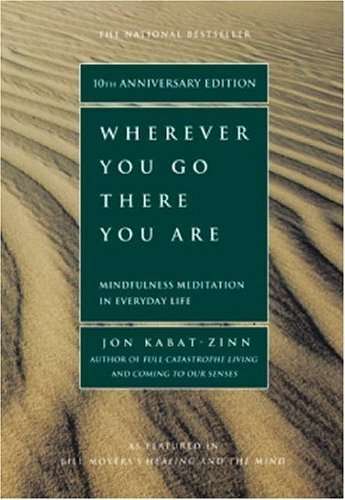
Wherever You Go, There You Are: Mindfulness Meditation in Everyday Life
Jon Kabat-Zinn’s “Wherever You Go, There You Are” is one of those books that sounds simple but actually delivers. If anxiety and stress have become constant background noise in your life, this book offers a genuine invitation to slow down and reconnect with yourself. Whether you’re working on communication in couples therapy or dealing with anxiety on your own, the mindfulness tools here can make a real difference alongside therapeutic work.
For those dealing with anxiety that feels persistent or overwhelming, working with a therapist can help sort out what’s going on and what kind of support would actually help. Anxiety disorders aren’t just “worrying a lot.” They involve a level of fear and apprehension that can genuinely interfere with daily life, and they affect people across all ages, though women experience them at roughly twice the rate of men.
The physical side of anxiety is real too: racing heart, sweating, trembling, a feeling of dread that won’t let up. When it gets to that point, mindfulness practices like the ones in this book can be a helpful tool, but they work best as part of a broader approach that includes professional support.
Mindfulness as a Path to Better Relationships
At its core, this book treats mindfulness not as some mystical practice but as a practical way to actually be present in your own life. For couples who feel disconnected, Kabat-Zinn’s teachings offer something surprisingly concrete: when partners learn to be fully present instead of mentally rehearsing comebacks or stewing over old arguments, the quality of their interactions changes.
A lot of couples therapists recommend mindfulness practices for good reason. Something as basic as mindful listening, giving your partner your full attention without planning what you’re going to say next, can break communication patterns that have been causing damage for years.
Kabat-Zinn brings real credibility to this work. He has a Ph.D. in molecular biology from MIT and spent decades developing mindfulness-based stress reduction (MBSR) in medical settings. He bridges scientific research and contemplative practice in a way that’s convincing even for people who are skeptical of anything that sounds too spiritual. The research-backed approach is reassuring: these practices have measurable effects on stress and emotional regulation.
Where This Approach Falls Short
For all its strengths, the book has some blind spots worth naming. Kabat-Zinn doesn’t really address how systemic factors like economic inequality, racism, or other forms of oppression affect someone’s ability to practice mindfulness. If you’re facing real external threats, being told to “just be present” can feel tone-deaf.
While he acknowledges the Buddhist origins of mindfulness, the Western, secularized approach strips practices from their cultural and ethical context. Some critics argue this reduces rich contemplative traditions to stress-management techniques without their deeper foundations.
That said, for couples in therapy, several concepts from the book have immediate practical value:
The notion of “non-doing” is a useful counterweight to feeling like you always need to be productive. A lot of relationship conflicts come from feeling unappreciated for all you “do.” Kabat-Zinn invites you to value just being together, without an agenda.
His writing about patience gives couples a framework for dealing with different processing speeds and communication styles. Learning to give your partner time to respond instead of pushing for instant resolution can change conflict patterns.
The chapter on letting go offers perspective for couples holding onto old hurts. It won’t replace the work of actually addressing relationship wounds, but it helps with not being constantly defined by them.
Using Mindfulness Alongside Therapy
If you’re working with a couples therapist or counselor, it’s worth asking how mindfulness practices might fit with what you’re already doing. A lot of therapists incorporate mindfulness into their approach and can help you adapt the book’s exercises to your specific situation.
If you’re reading on your own, start small. Even a few minutes of breathing together before a hard conversation can create a baseline of presence that makes the conversation go better.
The important thing to remember is that mindfulness isn’t about achieving some blissful state. It’s about becoming aware of whatever is actually happening, including the difficult stuff. That acceptance-based orientation fits well with therapy approaches that emphasize emotional awareness. When anxiety or other mental health concerns are serious, professional support matters. A therapist can help you figure out how mindfulness fits into managing anxiety alongside other treatment.
Lifestyle and Anxiety
Lifestyle changes can genuinely help with anxiety. Regular exercise, decent nutrition, and getting enough sleep aren’t magic cures, but they build a more resilient foundation for dealing with stress. They’re the basics, and they make everything else work better.
Stress management techniques, like deep breathing exercises and progressive muscle relaxation, can also take the edge off. They’re not going to solve the underlying issue on their own, but they help with the physical symptoms that make anxiety so draining.
Having people around who get it matters too. Connecting with friends, family, or a therapist provides emotional support and practical perspective. If your current circle doesn’t feel like enough, a support group or online community can help you feel less alone in it.
Working with a mental health professional to put together an approach that combines lifestyle changes, stress management, and therapy is usually the most effective path forward. Anxiety is rarely just one thing, and addressing it from multiple angles tends to work best.
Mindfulness in Your Relationship
While the book focuses mostly on individual practice, the principles translate naturally to relationships. Couples who practice mindfulness regularly tend to report better emotional regulation during fights, more genuine empathy, and a greater ability to respond thoughtfully instead of just reacting when things get heated.
Those are exactly the kinds of things couples therapy aims for, which makes mindfulness a solid complement to professional support. The skills of present-moment awareness and observation without judgment create a foundation for the vulnerable conversations that actually strengthen intimate bonds.
Find it on OpenLibrary here