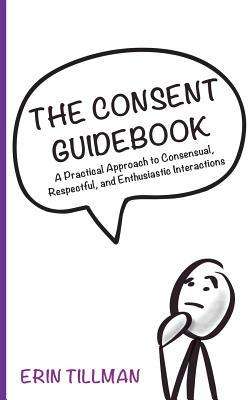
The Consent Guidebook: A Practical Approach to Consensual, Respectful, and Enthusiastic Interactions
Consent is one of those words that gets thrown around a lot right now, and for good reason. But there’s a weird gap between knowing consent matters and actually knowing how to practice it, especially in the messy, real-life situations where it gets complicated. A first date. A long-term relationship where assumptions have piled up over the years. A kink scene. A conversation with a friend who keeps pushing past your “no.” Most people think they understand consent until they’re in one of those moments and realize they don’t have the language for it.
Erin Tillman’s The Consent Guidebook fills that gap. It’s not a legal primer or an academic text. It’s a genuinely practical, accessible handbook that treats consent as a skill you build, not a box you check.
What this book actually covers
The subtitle says it: a practical approach to consensual, respectful, and enthusiastic interactions. And Tillman means all interactions, not just sexual ones. That’s one of the things that makes this book stand out. It starts with the basics of boundaries in everyday life, moves through digital consent (yes, that’s a thing, and yes, most people are terrible at it), explores how pop culture has warped our ideas about what “yes” and “no” look like, and eventually gets into enthusiastic consent in sexual contexts.
The structure works because it mirrors how consent actually operates in real life. You don’t learn to negotiate a BDSM scene before you’ve learned to say “I’d rather not” when a coworker keeps asking you personal questions. Consent starts small, and the book respects that.
Over thirty contributors, including sex educators, health professionals, HR managers, and civil rights leaders, weigh in throughout. That variety keeps the book from feeling like one person’s opinion dressed up as universal truth. Different perspectives on the same concept make the whole thing feel more honest.
The AASECT award and why it matters
This book won the 2021 AASECT (American Association of Sexuality Educators, Counselors, and Therapists) General Audience Book Award. That’s not a popularity contest. AASECT is the professional credentialing body for sex therapists and educators in the US, and their endorsement means the book meets a clinical standard for accuracy and usefulness.
For anyone considering sex therapy, this distinction matters. It means the content isn’t just well-intentioned. It’s been vetted by the same people who train and certify sex therapists. You’re getting something that aligns with how consent is actually discussed in clinical settings.
Why consent is a therapy conversation
Here’s the thing that doesn’t get said enough: a lot of people end up in therapy partly because of consent issues they don’t have words for yet. Not necessarily assault or obvious boundary violations, though those too. More often it’s the slow accumulation of smaller things. Going along with sex you didn’t really want. Not knowing how to say what you actually like. Feeling guilty for having limits. Partners who treat “maybe” as “yes” and “not right now” as a problem to solve.
These patterns show up constantly in couples work, in individual therapy around sex, and especially in kink and non-monogamy where explicit negotiation is part of the deal. The Consent Guidebook gives people a framework for recognizing and naming these dynamics, which is often the hardest part. Once you can see the pattern, you can start changing it.
Where this connects to kink and non-monogamy
If you’re involved in kink or BDSM, you already know that consent isn’t just important, it’s the entire foundation. Safe words, negotiation, aftercare, checking in. The kink community has been doing consent work longer and more explicitly than mainstream culture, and Tillman’s framework dovetails nicely with that existing knowledge.
But even experienced kink practitioners can hit blind spots. Consent outside the scene, for one. The subtle power dynamics that bleed into everyday interactions with a partner. Or renegotiating when something that used to be a “yes” has shifted. The book addresses these gray areas without being preachy about it, which is refreshing in a space where a lot of consent resources either talk down to kinky people or ignore them entirely.
For anyone working with a kink-aware therapist, this can be a useful reference point. It gives shared language for conversations that might otherwise feel awkward to start from scratch.
The same applies to polyamory and non-monogamy. When you’re in multiple relationships, consent gets more complex by default. Agreements ripple outward. New partners get brought into existing dynamics. Someone’s boundaries change and suddenly the whole structure needs renegotiating. Tillman doesn’t write specifically about ENM, but the ideas carry over.
The survivor support angle
The book includes a section on supporting survivors, and it handles it without the usual condescension. It doesn’t try to be a trauma recovery manual, which is good because that’s not what it is. What it does is help people understand how consent gets complicated after someone’s boundaries have been violated. How rebuilding trust in your own “yes” and “no” takes time. How well-meaning partners can accidentally re-create harmful dynamics without realizing it.
If you’re doing trauma work in therapy, this section can be a useful companion. Not as a replacement for clinical support, but as a way to think about consent in your daily life while you’re processing bigger stuff in session.
What it gets right
The book’s biggest strength is its accessibility. Tillman writes like she’s talking to a friend, not lecturing a classroom. The illustrations of consensual vs. non-consensual scenarios are simple and effective. No jargon, no guilt trips, no assumption that the reader is either a predator or a victim. Just clear, grounded advice about how to be better at this one thing that affects literally every relationship you have.
The range of contributors keeps it from being one-dimensional. You get perspectives from sex educators, civil rights leaders, corporate HR professionals, and health workers. Consent looks different in a boardroom than in a bedroom, and the book acknowledges that without pretending one context is more important than the other.
Where it has limits
This is a broad-audience book by design, which means some topics get a surface-level pass. If you’re looking for deep clinical guidance on consent in the context of trauma recovery, dissociation, or complex relational dynamics, you’ll need to pair it with more specialized resources and, ideally, a therapist who’s comfortable going deeper.
The kink and BDSM content is present but not extensive. Tillman touches on enthusiastic consent in sexual contexts and the basics of negotiation, but if you’re looking for scene-specific negotiation frameworks, books like The New Topping Book and The New Bottoming Book go further.
And while the book is inclusive in tone, it’s not specifically centered on queer, trans, or non-monogamous experiences. The principles apply, but you may find yourself doing some translation work to fit your specific situation.
About Erin Tillman
Erin Tillman is a Certified Sexuality Educator (CSE) and dating empowerment coach based in Los Angeles. She’s also a certified NLP practitioner, speaker, and media personality. She wrote The Consent Guidebook during the early #MeToo momentum. The cultural conversation had exposed something she found hard to ignore: most people had never been explicitly taught how consent works in practice.
Tillman doesn’t come at consent from a fear angle. The book isn’t about scaring people into compliance. It’s about giving people the tools to be more intentional about how they interact with everyone in their lives — partners, coworkers, family, all of it.
Getting the most out of this book
A few ways to use it, whether or not you’re in therapy:
- Read it before a hard conversation. If there’s a relationship where boundaries keep getting crossed and you haven’t been able to articulate why, this book can give you the framework.
- Use it as a shared reference with a partner. Reading the same consent material together tends to surface assumptions neither of you knew you had.
- If you’re in therapy, flag the sections that resonate or that you disagree with. Both reactions are worth exploring. Sometimes the strongest reaction points to the most useful conversation.
- If you’re exploring kink or non-monogamy for the first time, start here before diving into scene-specific resources. Get the foundation right first.
What to read next
If The Consent Guidebook resonates, a few directions to go depending on what drew you in:
For kink-specific consent and negotiation, The New Topping Book and The New Bottoming Book are the standards. Different Loving offers a broader exploration of BDSM and power exchange dynamics.
If the consent-after-trauma angle spoke to you, Healing Sex by Staci Haines takes a somatic approach to rebuilding a relationship with your body and sexuality after violation. Reclaiming Pleasure by Holly Richmond picks up where most trauma books stop and focuses on getting desire back.
For consent in the context of open relationships, The Ethical Slut remains foundational, and Building Open Relationships offers a hands-on guide to structuring non-monogamous partnerships with clear agreements.