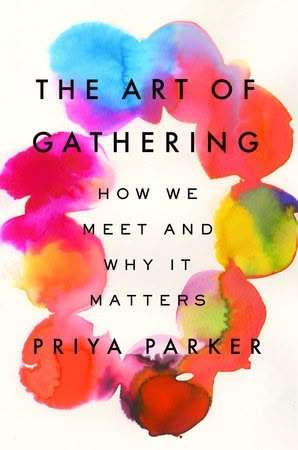
The Art of Gathering: How We Meet and Why It Matters
Priya Parker’s background does not look like it should end in a book about dinner parties. She was mentored in Sustained Dialogue by Harold Saunders, ran race-relations work on American college campuses, and worked on peace processes in the Arab world, southern Africa, and India. She also grew up shuttling between an Indian Buddhist mother and a white evangelical Midwestern father, which is its own training in how one room can run on two incompatible sets of rules.
Then she wrote three hundred pages about why your birthday party was boring.
That path is the reason the book is worth reading. Parker is a professional facilitator, not a therapist and not an event planner, and she came to gatherings from conflict work. So she doesn’t treat a room as a logistics problem. She treats it as a negotiation between people who all want slightly different things and mostly won’t say so. Chapters titled “Cause Good Controversy” and “Close Doors” come out of that history, not out of a wedding blog.
A Category Is Not a Purpose
Parker’s central claim is that most gatherings fail long before anyone arrives, at the moment the host decides what the thing is by naming its category. Birthday party. Staff meeting. Thanksgiving. A category tells you what to buy and roughly how long it lasts. It tells you nothing about what should happen to the people in the room.

Purpose is the other thing, and it has to be specific enough to rule options out. “I want my two oldest friends to actually know each other by the end of the night” is a purpose. “Dinner” is a category wearing a purpose costume. Once you’ve got a real one, Parker argues, it decides everything downstream: who’s invited, where you do it, whether anyone speaks, when it’s over.
She’s right, and the reason the insight lands is that almost nobody does it. Most gatherings run on autopilot, assembled from whatever the last one looked like.
Parker Assumes You’re the Host
Here is where the book and a lot of its most interested readers part company. Every tool in it belongs to the person holding the invitation. Her case studies skew corporate and affluent, and they’re mostly things she or a client built from scratch: retreats, salons, conferences, a fifteen-person dinner with a designed opening. She has not had to run a two-hundred-person wedding with a seating chart negotiated by aunts, or a funeral where the guest list is whoever the obituary reached. Advice about closing doors assumes the door is yours to close.
Plenty of people who need this book don’t have that. They’re going to their mother’s house in December. They’re a guest at a gathering somebody else already designed badly, and the design is decades old.
The frame survives the transfer anyway, if you shrink the room. Deciding whether to go at all, how many hours you’ll stay, which relative gets the real version of your life and which gets the weather report, where you go when it gets bad, who drives you home: that is designing a gathering. It’s just nested inside somebody else’s. Purpose still filters every decision. You simply have fewer decisions to make.
Read Chapter 2 First If a Family Visit Is Coming
Skip the introduction and start with “Close Doors.” Parker’s argument there is that exclusivity isn’t rudeness, it’s structure. Who you leave out defines a group as much as who you let in, and a gathering that tries to include everyone ends up meaning nothing to anyone. She’s talking about guest lists.
For someone flying home for the first time since transitioning, or bracing for the annual dinner where they’ll be deadnamed by the same person who did it last year, that chapter does something she probably didn’t plan. It makes exclusion a design choice instead of a moral failure. If you can’t control the guest list, you can still control yours: which two hours you’re genuinely present for, which cousin you tell the truth to, which conversations you decline to have while passing the potatoes.
Boundaries usually get taught as limits, the sentence you say no with. Parker’s version is a room you build on purpose. If you’re already working through family boundaries with a therapist who specializes in trans-affirming care, this book gives you language for the shape of the room, not just the wording of the limit.
When There’s No Script to Inherit
Chapter 4 is the one about building a temporary alternative world: thresholds, rules, small rituals that mark a gathering as different from ordinary Tuesday life. Go there if you’re inventing something rather than surviving something. A first holiday hosted by a chosen family after estrangement. Four people and two sets of in-laws trying to work out what December looks like now. A commitment ceremony that no inherited template for polyamorous or non-monogamous relationships covers, where you’re writing the rules from nothing.

People in that spot tend to do one of two things. They stage a hollow imitation of their parents’ version, complete with the parts nobody liked, or they skip ritual entirely and end up with a perfectly nice meal that doesn’t feel like anything happened. Parker’s answer is to build the rules deliberately and then say them out loud. Everyone answers one question before the food. Phones in the bowl. This starts now, and here’s why we’re doing it.
Written down it sounds twee. In practice it works, and it’s the same mechanism that makes a therapy group feel unlike ordinary conversation: a room with a stated contract behaves differently than a room without one.
Most Gatherings End. Few of Them Close.
The last chapter is about that gap, and it’s the one to read if you’re marking a loss. Parker’s observation is that gatherings mostly fizzle. People drift toward their coats, somebody starts stacking plates, nobody says the thing that everyone came to hear. Closing takes a host willing to stand up and do it.
Pair it with Chapter 5, “Never Start a Funeral with Logistics,” which is about openings that orient people emotionally instead of administratively. Both chapters earn their keep for anyone holding a memorial that a biological family refused to hold, or building some kind of ceremony around the end of a marriage. Working through what that loss actually means is its own kind of work; this book only covers the room it happens in. The difference between a gathering that helps and one that leaves everyone lonelier is often just whether someone was willing to name the beginning and the end.
Where the Book Stops
It’s a hosting book. That’s the honest limit. It will help you build the room, and it will not repair the relationship sitting across the table or process the loss you’ve gathered around. Anyone coming to Parker for depth on what gatherings mean, as opposed to how they’re constructed, will need something else next to her.
The middle stretch on hosting mechanics is also skippable. If you came for the relational and boundary material, the chapters on chill hosting and seating and food are for a different reader. Three chapters of a good book is a fine amount of a good book to read.
If the harder question underneath all this is what chosen family looks like when it actually works, rather than how to run an evening, Mia Birdsong’s How We Show Up covers that ground with more warmth and less structure. And if you got to this page because the boundary problem is louder than the hosting problem, Unfuck Your Boundaries is the blunter, more hands-on place to start.