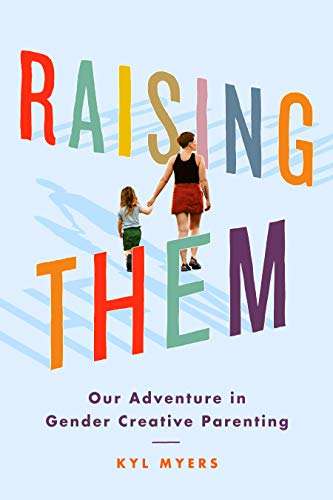
Raising Them: Our Adventure in Gender Creative Parenting
Kyl Myers has a PhD in sociology and gender studies, identifies as a genderqueer woman, and decided before her first child was even conceived that she wasn’t going to assign them a gender. That child, Zoomer, spent their first four years being called “they,” wearing whatever they wanted, and growing up without anyone outside the family knowing their biological sex. This book is the story of how that went.
It went mostly fine. That’s the honest summary. Myers and her husband Brent made a series of quiet daily choices about pronouns, clothing, toys, and language, and Zoomer turned out to be a happy, curious kid who started choosing their own gendered labels around age four with a more sophisticated understanding of what those labels mean than most adults have.
What this book is and what it isn’t
This is a memoir. Not a parenting manual, not a clinical framework, not a research synthesis. Myers weaves in sociological data about how gender stereotypes form in early childhood, but the core of the book is her family’s story: the decision, the daily logistics, the extended family reactions, the viral media attention after a 2018 New York magazine piece, and the chapter she dedicates to the queer community around Zoomer.
If you’re looking for a step-by-step guide to gender creative parenting, this won’t give you that. What it will give you is a detailed picture of what one family’s version looked like in practice: the conversations with grandparents, the daycare negotiations, the stranger encounters, the small daily moments where gendered assumptions show up and have to be handled.
Myers’ framing helps here. Her goal, as she puts it, isn’t to create a genderless world but “to contribute to a gender-full one.” She’s not against gender. She’s against having it assigned to you before you can speak.

Who picks this book up and why
The people who get the most from this are parents of young children who sense that rigid gender expectations are limiting but haven’t seen what a looser approach looks like in real life. Not in theory. In actual Tuesday-morning-getting-dressed-for-daycare practice.
It’s also useful for queer parents or prospective parents thinking through how their own experiences with gender might shape their parenting. And for couples where one partner wants to relax gender norms and the other feels anxious about it, the book works as a low-stakes conversation starter because Myers documents the outcomes, not just the philosophy.
For adults in therapy examining how their own childhood gender socialization still affects them, Myers’ early chapters about growing up in a conservative religious environment and slowly rethinking everything she was taught might land differently than an academic text on the same subject.
The privilege problem
The book knows it has one, but doesn’t do enough about it. Myers is white, financially stable, well-educated, living in progressive Salt Lake City with supportive employers and a robust community. She acknowledges this. The acknowledgment doesn’t make the book more useful for a family trying gender creative parenting in a hostile school district, or without economic security, or while also dealing with racism.
Several reviewers flagged the tone as relentlessly sunny. The cute Zoomer anecdotes pile up. The struggles feel manageable. There’s a real question about how transferable any of this is outside the specific conditions Myers happened to have. The book is honest about what happened. It’s less honest about how much of what happened depended on circumstances most families don’t share.
And Zoomer is four when the book ends. The hard parts of gender in childhood, the peer pressure, the school system, puberty, none of that is here yet. This is the easy chapter of a longer story.

What a therapist might do with this
In family therapy, the most useful sections are the ones about extended family. When grandparents push back on a family’s approach to gender, or when relatives refuse to use a child’s pronouns, Myers’ documentation of those conversations gives families something concrete to reference. Not as a script, but as proof that the conflict is survivable and the relationship can still function.
For parents whose kid is gender-nonconforming and who need to see that loosening expectations is possible without catastrophe, the whole book serves that purpose. It’s not about a child expressing gender variance. It’s about a parent choosing not to impose constraints. But the practical effect, a kid who gets to be who they are, is the same.
The book pairs well with clinical work on gender identity in children, though it shouldn’t replace it. If your family is working through questions about a child’s gender with a therapist who understands both trans-affirming care and family dynamics, this is a companion read. It fills in the lived-experience piece that clinical frameworks sometimes miss.