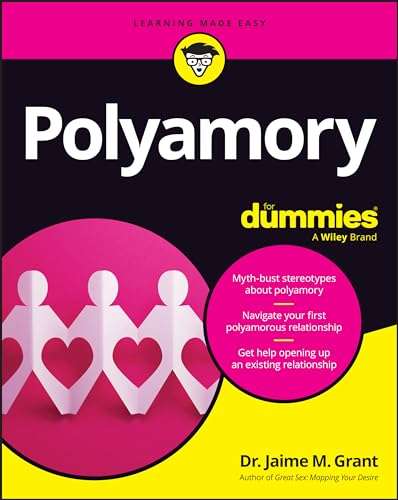
Polyamory For Dummies
If you’ve recently realized monogamy isn’t the only option, or you’re in a relationship that’s opening up and you’re not sure what comes next, the sheer volume of information out there can feel overwhelming. Where do you even start when the questions range from “how do I tell my mom” to “how do I handle jealousy when my partner is on a date”?
Polyamory For Dummies by Jaime M. Grant, PhD does what the Dummies series does best: it takes a complicated subject and breaks it down without dumbing it down. Grant, an activist, researcher, and coach with over 30 years of experience in LGBTQ+ and women’s issues, brings both academic rigor and real-world warmth to a topic that a lot of books either over-romanticize or treat like a problem to solve.
What Does This Book Actually Cover?
The book moves through polyamory in a logical sequence, starting with the fundamentals (what polyamory is, what it isn’t, whether it might be right for you) and working toward the more nuanced territory that comes up once you’re actually in it. There are chapters on:
- Understanding the different structures: primary/secondary, solo poly, relationship anarchy, polycules
- Jealousy — not as something to eliminate but as something to understand and work with constructively
- Coming out as poly to partners, family, friends, and coworkers
- Consent, boundaries, and agreements that actually hold up under pressure
- Specific situations like parenting while poly, disability and poly, and aging in non-monogamous relationships
That last point is worth noting. A lot of poly resources skew young and able-bodied. This book makes room for people whose lives don’t fit that mold.
What It Gets Right and What It Misses
The biggest strength here is accessibility. If you hand this to someone who’s never heard the word “metamour,” they’ll be up to speed by chapter three. Grant writes clearly without being patronizing, and the research backing gives the advice more weight than pure opinion.
The book is also genuinely inclusive in a way that goes beyond lip service. It addresses multi-gender and multi-sexuality polycules directly, which a lot of older poly resources gloss over or ignore entirely.
Where it’s lighter is in the emotional deep-dive territory. If you’re looking for a book that really gets into the psychological complexity of jealousy, attachment, or the grief that can come with relationship transitions, you’ll want to supplement this with something like Polysecure. This is a solid overview, not a deep excavation.
The section on coming out as poly deserves a mention on its own. Grant doesn’t treat it like a single conversation — she breaks it down by audience (partner, family, coworkers, kids) and acknowledges that each one has completely different stakes. The advice for workplace situations is particularly practical: when to disclose, when not to, and how to handle the fallout if someone else outs you. Most poly books skip this entirely or hand-wave it with “be authentic,” which isn’t always useful when your job is on the line.
Grant also addresses what happens when polyamory doesn’t work out. Not every relationship structure survives the transition, and the chapter on breakups and relationship changes in poly contexts is refreshingly honest. She doesn’t frame every ending as a failure — sometimes people discover that what they actually want looks different than what they thought, and that’s valuable information even when it hurts.
Reading This Alongside Therapy
If you’re already working with a therapist on non-monogamous relationship questions, reading this beforehand gives you shared vocabulary. It makes conversations in session more productive when you’re not starting from scratch on the basics.
It’s especially useful if you’re in the early stages: figuring out what you want, having the first conversations with a partner, or managing the anxiety that comes with doing something you’ve never done before. The practical structure means you can read a chapter and bring specific questions to your next session rather than showing up with a vague “I’m overwhelmed.”
Is This the Right Book for You?
Pick this up if you’re at the beginning. If you’re poly-curious, newly poly, or trying to understand a partner who is. If you want clear information without having to wade through someone’s personal memoir to get it. If you learn well from structured, research-backed guides that respect your intelligence.
Skip it if you’ve been poly for years and already have a solid foundation. And if you’re dealing with specific emotional challenges like attachment anxiety in open relationships or processing a difficult breakup, a book won’t replace working with someone who specializes in this. A free consultation is a good place to start figuring out what kind of support would actually help.
What to Read Next
If this book gets you oriented and you want to go deeper, a few good next steps:
Polysecure by Jessica Fern is the natural follow-up. Where Grant gives you the overview, Fern goes deep on attachment theory and how your early relationship patterns show up in non-monogamous dynamics. If jealousy or anxiety is your main struggle, start here next.
The Ethical Slut by Janet Hardy and Dossie Easton covers similar ground but with a longer history and a more sex-positive, freewheeling tone. It’s been around since 1997 and has shaped a lot of how people think about ethical non-monogamy.
Opening Up by Tristan Taormino fills in the practical gaps with interviews from people in all kinds of open relationship structures — useful for seeing how the theory plays out in real lives.