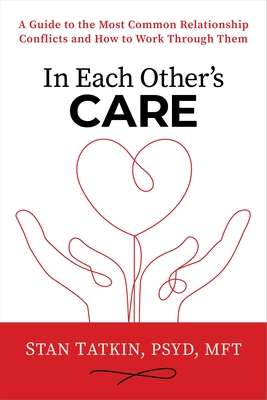
In Each Other’s Care: A Guide to the Most Common Relationship Conflicts and How to Work Through Them
In Each Other’s Care: A Guide to the Most Common Relationship Conflicts and How to Work Through Them tackles the fights that couples have over and over — money, sex, chores, parenting, in-laws, betrayal — and offers a framework for breaking the cycle. Stan Tatkin, PsyD, MFT, developed the Psychobiological Approach to Couple Therapy (PACT), and this book brings that approach out of the therapy office and into something you can actually use at home.
What Stands Out
Tatkin has a knack for making neuroscience feel personal. The book’s central concept — secure functioning — is about building a two-person system where both partners are genuinely looking out for each other. Not in a vague “be nicer” way, but in a specific, operational way. He breaks down how your nervous system reacts during conflict, why certain arguments trigger disproportionate responses, and what’s actually happening in your brain when you shut down or blow up.
The writing is warm without being soft. Tatkin brings decades of clinical experience, and it shows in the sample dialogues and case studies scattered throughout. These aren’t sanitized therapy-brochure examples. They sound like real people having real arguments, which makes the advice feel applicable rather than theoretical.
Each chapter focuses on a specific conflict area and includes practical exercises. Not “reflect on your feelings” exercises, but concrete scripts and techniques for de-escalating in the moment. There’s a section on how to repair after a fight that’s one of the more useful things I’ve seen in a couples book.
Where It Falls Short
The PACT model centers on committed, cohabiting couples. If you’re in a non-traditional relationship structure, whether polyamorous, long-distance, or something else, you’ll need to adapt the framework yourself. Tatkin doesn’t address these dynamics directly, and the assumption throughout is two people building one shared life.
The book can also feel prescriptive. Tatkin is confident in his model, and that confidence sometimes tips into a tone that implies there’s one right way to do relationships. Some couples may find that reassuring. Others might feel like they’re being told their way of relating is wrong rather than just different.
And while the neuroscience grounding is a strength, it occasionally gets in the way of practical flow. Some readers will love the explanations of how the amygdala and vagus nerve factor into arguments. Others will want to skip to the “what do I actually do” parts.
The Fights Behind the Fights
Where this book is strongest is in helping couples see what’s really driving their repetitive conflicts. The fight about dishes is rarely about dishes. Tatkin is good at mapping the attachment dynamics underneath — who feels abandoned, who feels controlled, where the old wounds are getting activated by present-day triggers.
This is the kind of insight that can shift a relationship from “we keep having the same fight” to “oh, that’s what’s actually going on.” And that shift, in therapy or out of it, is where things start to change.
Using This Book Alongside Therapy
If you’re already in couples therapy, this book can accelerate the work. It gives you language and frameworks to practice between sessions, which is where most of the actual change happens anyway. The scripts are especially useful for couples who know they need to communicate differently but freeze up when they try.
If you’re not in therapy but considering it, reading this book might help you figure out what you actually need. Some couples discover that the book gives them enough tools to make progress on their own. Others realize that having a third person in the room would help them apply what they’re reading. Both are fine outcomes.
Is This Book for You?
This works best for couples who are committed and willing to do the work but stuck in patterns they can’t break on their own. It’s less about whether your relationship is “good” or “bad” and more about whether you’re both ready to look at what’s happening under the surface.
Less useful if your primary challenge is something the book doesn’t cover, like queer relationship dynamics specifically, or if one partner isn’t interested in engaging with the material. Couples work, whether in a book or in a therapy room, requires both people to show up.
Further Reading
Tatkin’s earlier book Wired for Love covers similar territory with more emphasis on attachment styles and the neurobiology of pair bonding. Attached by Amir Levine and Rachel Heller is a lighter, more accessible introduction to attachment theory if you want to start there. And Hold Me Tight by Sue Johnson approaches couples conflict from an emotionally focused therapy perspective that complements Tatkin’s neurobiological lens.
If you’re ready to work on this with support, schedule a free consultation with a couples therapist who can help you figure out the right next step.