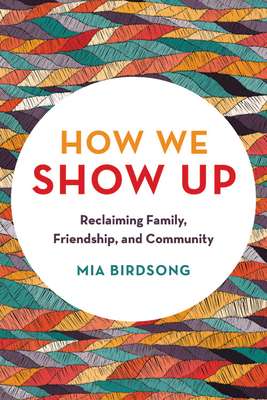
How We Show Up: Reclaiming Family, Friendship, and Community
The Loneliness That Doesn’t Make Sense
You’ve done the things you were supposed to do. You’ve got your apartment, maybe a partner, a career that keeps you busy. And still, there’s this quiet ache that something’s missing. Not a romantic thing, not a professional thing. Something about how isolated all of it feels. You text your friends more than you see them. You barely know your neighbors. When something goes wrong, really wrong, you’re not sure who you’d call at 2 a.m.
Mia Birdsong wrote How We Show Up out of exactly this disconnect. She’s a community organizer and activist who spent years working at the Family Independence Initiative and co-directing Family Story, an organization that challenges narrow ideas about what makes a “real” family. An Ascend Fellow at the Aspen Institute, she’s spent time doing everything from organizing prison abolition work to apprenticing as a midwife. This book came out of watching people chase a version of success that leaves them profoundly alone, and then asking what it would look like to build something different.
What the Book Is Actually About
The subtitle says “Reclaiming Family, Friendship, and Community,” and Birdsong means each of those words in the widest possible sense. Family isn’t limited to blood relatives or the people you live with. Friendship isn’t the thing you squeeze in between work obligations. Community isn’t your Instagram followers.

Birdsong argues that American culture has trained us to prioritize romantic partnership and nuclear family above every other kind of relationship. Your spouse is supposed to be your best friend, your co-parent, your financial partner, your emotional support, your everything. And when that one relationship can’t hold all of that weight (because no single relationship can), we blame ourselves or our partner instead of questioning the structure.
She calls this the “relationship hierarchy,” and she wants to break it apart. Not to diminish romantic relationships, but to take the pressure off them by investing seriously in friendships, chosen family, neighbors, the people who actually make up your daily life. She draws on interviews and personal stories from people who are doing this, many of them from communities of color, queer communities, and low-income communities where interdependence has always been a survival strategy rather than a lifestyle choice.
Smashing the Relationship Hierarchy
This is probably the most useful idea in the book for people who end up in therapy. Birdsong makes the case that treating your romantic partner as the center of your entire social and emotional world puts an impossible burden on that relationship. When you don’t have close friendships, when you’ve let community ties thin out, your partner becomes responsible for meeting needs that used to be spread across a whole network of people.
People in non-monogamous relationships will recognize this concept immediately, but Birdsong is after something more basic: the idea that deep, committed, show-up-at-2-a.m. friendships deserve the same intentionality we give to romantic partnerships. That raising kids works better with more than two exhausted parents locked in a box together. That knowing your neighbors, and being known by them, matters more than the culture gives it credit for.
For people in couples therapy, this reframe can be genuinely relieving. A lot of the pressure couples feel comes from trying to be everything to each other. Birdsong gives language for why that pressure exists and what it might look like to distribute it more honestly.
Vulnerability as Infrastructure
Birdsong spends a good portion of the book on vulnerability, and she skips the self-help-book version of the word entirely. Forget being brave enough to share your feelings. She’s after something more structural: being honest about what you need, and willing to ask for help, is what makes real community possible.

She tells stories about people who share childcare, who combine households, who show up for each other through addiction and illness and financial crisis. The throughline is that none of it works without being willing to say “I can’t do this alone.” That’s harder than it sounds in a culture that treats independence as the highest virtue.
For queer and LGBTQ+ people, a lot of this will feel familiar. Chosen family has been a cornerstone of queer survival for decades, born out of necessity when biological families couldn’t or wouldn’t provide support. Birdsong names this explicitly, and she credits the communities that built these models long before mainstream culture caught on.
What the Book Doesn’t Quite Do
Birdsong is a better storyteller than she is a practical guide. The book is strong on vision, and some of the stories are genuinely moving. But if you’re looking for a step-by-step plan for building the kind of community she describes, you won’t find it here. She tells you what it looks like when it works. She’s less clear on how to get there if you’re starting from scratch in a city where you don’t know anyone.
The book also centers specific communities and experiences. Birdsong writes from her perspective as a Black woman and activist, and many of her examples come from communities of color and from people already embedded in activist networks. If your life looks different from that, you may need to do some translation. The principles transfer, but the specific pathways might not.
There’s also a tension between the book’s political framework and its self-help impulse. Birdsong is clear that isolation is a systemic problem as much as a personal one. But individual readers still need to know what they can do with that understanding. The balance tips toward diagnosis more than treatment.
Further Reading
If How We Show Up hits something for you, these books go deeper into related territory:
Pleasure Activism: The Politics of Feeling Good by adrienne maree brown approaches community and connection from a different angle, centering joy and desire as political acts. Brown and Birdsong read like they’re in conversation with each other, and pairing the two gives you a fuller picture of what liberatory community-building looks like in practice.
How to Be an Antiracist by Ibram X. Kendi. Birdsong’s book deals with race and systemic oppression throughout, but if you want to go deeper into the structural forces that create the isolation she describes, Kendi’s framework is essential reading.
Hold Me Tight: Seven Conversations for a Lifetime of Love by Sue Johnson. If Birdsong’s chapter on relationship hierarchy made you think about what’s happening in your own partnership, Johnson’s emotionally focused approach gives you concrete tools for strengthening that bond. The two books complement each other well: Birdsong expands your idea of who matters, Johnson helps you deepen the specific connections you have.
Conscious Loving: The Journey to Co-Commitment by Gay and Kathlyn Hendricks takes a broader look at what honest, intentional partnership requires. Less political than Birdsong, more focused on the inner work of showing up fully in your closest relationships.