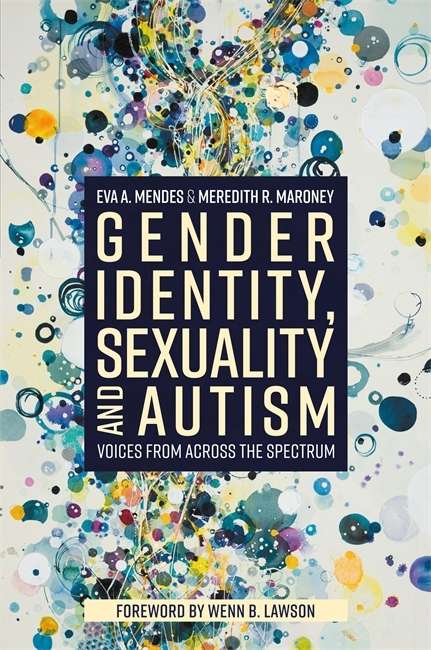
Gender Identity, Sexuality and Autism
Eva Mendes and Meredith Maroney’s 2019 book does something most resources on autism or LGBTQ+ identity don’t bother with: it treats both as real at the same time.
That sounds like a low bar. It isn’t. Most autism books treat queerness as a footnote, if they mention it at all. Most LGBTQ+ resources assume neurotypical social wiring: the coming out narratives, the community-building scripts, the relationship templates all run on a set of assumptions about how people process social information. If you’re autistic and queer, you’ve probably noticed the gap. This book exists because that gap is enormous.
The research backs this up in ways that are hard to ignore. Autistic people are three to six times more likely to identify as transgender than the general population. Autistic women are three to four times more likely to identify as bisexual. Somewhere between 15 and 35 percent of autistic adults identify as LGBTQ+, compared to roughly five percent of the general population. Those aren’t small numbers. And yet the resources available for people living at that intersection could fit on a short shelf.
What the book actually is
It’s a collection of first-person narratives from autistic LGBTQ+ people. Their experiences of figuring out gender, sexuality, coming out, relationships, and what support looked like or didn’t. Mendes is a licensed mental health counselor with her own ADHD diagnosis; Maroney is a counseling psychologist whose research focuses specifically on minority stress at this intersection. The foreword is by Wenn Lawson, an autistic trans man and registered psychologist who’s published over twenty books on autism.
The structure is straightforward. Part one lays out the research context. Part two is the narratives themselves, organized by identity. Part three pulls themes across those stories and includes a clinical Q&A section plus the Mendes-Maroney Autism Diagnostic Key, which several readers have called more accessible than standard screening tools like the AQ-10 or RAADS-R.
It won the APA Division 44 Award in 2021 (the Society for the Psychology of Sexual Orientation and Gender Diversity), so it’s not a fringe pick.
The narratives are the point
The clinical framing matters, but Part two is where this book earns its keep. The first-person accounts do what no third-person summary can: they show you what it actually feels like to be autistic and queer, not in theory, but in the specific, sometimes contradictory, often messy reality of individual lives.
Maybe you’re autistic and have been trying to explain to a therapist how your experience of gender or sexuality doesn’t map onto the usual frameworks. These stories might be the first time you feel like someone’s describing your actual life and not a clinical approximation of it.
For parents whose autistic kid just came out, the narratives from family members might matter more than any clinical chapter could. There’s something about reading another parent’s honest confusion and gradual understanding that does more than a list of best practices.

Who should actually skip to what
Not everyone needs to read this cover to cover. The interview format gets repetitive after five or six narratives, which is the most common criticism, and it’s fair.
Therapists working with autistic LGBTQ+ clients should start with Part three. The Q&A section addresses the clinical questions you actually have, and the diagnostic key is immediately useful. Then go back and read two or three narratives that match your client population. You don’t need all of them to get the picture.
Autistic readers exploring their own identity can go straight to Part two and find the narratives closest to their experience. The research context in Part one is interesting but not essential.
Family members will get the most from the Part three Q&A, which was written with their questions in mind. Read that first, then the family-perspective narratives in Part two.
Where the book falls short
The sample is overwhelmingly white, middle-class, college-educated, and northeastern U.S. That’s a real limitation. The experience of being autistic and queer looks different when you’re also dealing with poverty, or racism, or immigration, or living in a rural conservative community. The book doesn’t pretend otherwise, but it also doesn’t do much about it.
Some readers have flagged that the family Q&A section slips into reassuring parents that their child being queer “isn’t their fault,” language that frames queerness as something requiring reassurance rather than just being. The intent is clearly to reach resistant parents where they are. Whether that trade-off is worth it depends on your perspective.
And the book is from 2019. The research on autism and gender diversity has expanded significantly since then. A large Cambridge University study has since confirmed the overlap with much bigger numbers. The foundational insight of the book holds up. Some of the specific data points are now outdated.

The intersection nobody talks about in therapy
Here’s what makes this book genuinely useful from a therapeutic standpoint: it names a specific problem that a lot of autistic queer people encounter in therapy and don’t know how to articulate.
The problem is this: standard LGBTQ+ affirming therapy assumes you can read and respond to social cues in neurotypical ways. The coming out process, community belonging, reading attraction signals, establishing intimate relationships. All of these have a social-processing component that gets glossed over when the therapist doesn’t understand autism. And standard autism-focused therapy often treats sexuality and gender as secondary concerns, something to address after the “real” issues.
Finding a queer therapist in NYC who also understands neurodivergence is specifically what this book argues people at this intersection need. Not someone who’s affirming on one axis and clueless on the other.
If you’re working with a therapist on questions about gender or sexuality and you’re also autistic, or suspect you might be, this book gives you language for what’s different about your experience. It’s not a replacement for therapy that accounts for both, but it’s a useful companion to that work.
What to read alongside this one
A few others in the collection approach related territory from different angles.
My Gender Workbook by Kate Bornstein is a much more playful, interactive approach to gender identity questions. Less clinical, more “figure it out as you go.” It doesn’t address autism specifically, but the open-ended framework works well for people who don’t fit neat categories.
Raising Them by Kyl Myers is useful for parents thinking about gender-creative parenting. A different angle than Mendes and Maroney, but relevant if your family is working through some of the same questions.
For the sensory and body-level dimensions of identity and intimacy that autistic people often navigate differently, Somatic Therapy approaches can address what talk therapy sometimes misses.