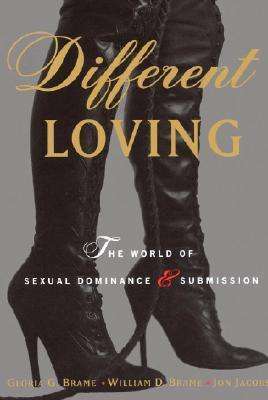
Different Loving: A Complete Exploration of the World of Sexual Dominance and Submission
There’s a version of the kink conversation that goes like this: someone works up the nerve to tell their therapist about their interest in BDSM, and the therapist either panics, pathologizes it, or goes quiet and clearly uncomfortable. If you’ve been through that, you already know how isolating it is. And if you haven’t, but you’ve been carrying shame about your desires for years, you probably understand why so many people in the kink community avoid therapy entirely.
Different Loving was one of the first books to push back against that whole dynamic. Published in 1993, when almost nobody in mainstream publishing was willing to treat BDSM as anything other than a disorder, Gloria Brame, William Brame, and Jon Jacobs spent years interviewing over a hundred people who practice dominance and submission, fetishism, sadomasochism, and other forms of power exchange. What they produced isn’t a clinical manual or a how-to guide. It’s a portrait of real people living real lives that happen to include kink.
A Hundred People Telling Their Own Stories
The core move of Different Loving is simple but radical: it treats kink practitioners as the experts on their own experience. Instead of filtering everything through psychiatric frameworks about what’s “normal,” the Brames let people speak for themselves. About how they discovered their desires. How they make their relationships work. What dominance and submission actually feel like from the inside.
If your only reference points for kink are pop culture stereotypes or pathologizing clinical literature, reading firsthand accounts of people who have built entire lives around power exchange can be genuinely reorienting. These are people who are happy, thoughtful, and deeply intentional about their relationships. That’s a far cry from the “damaged goods” narrative that a lot of kinky people have internalized.
What’s Dated (And It’s Not Nothing)
Let’s get this out front: this book is from 1993, and some of it shows. The language around gender and sexuality has evolved significantly since then. Some of the categories and terminology feel clunky by current standards. The interview pool, while diverse for its era, doesn’t fully represent the range of identities you’d find in today’s kink communities.
The book covers D/s dynamics, leather culture, fetishism, sadomasochism, cross-dressing, and more. Some of these categories reflect 1990s understandings that don’t map cleanly onto how people identify now. That’s worth knowing going in.
But the core insight holds up completely: people who practice kink are whole, functional human beings whose sexuality deserves respect rather than diagnosis. It took the psychiatric establishment until 2013 to formally stop classifying consensual kink as a disorder (DSM-5 distinguished between paraphilias and paraphilic disorders). The Brames were decades ahead of that shift.
What the Interviews Actually Reveal
The interview format is the real strength here. There’s something about hearing someone describe, in their own words, the first time they realized they were into submission, or the way they built trust with a dominant partner over months, that no clinical paper can replicate. These aren’t case studies. They’re people talking honestly about their lives.
The book is honest about the messiness, too. People contradict themselves, describe experiences that don’t fit clean categories, talk about the parts that are complicated alongside the parts that feel right. Real sexuality doesn’t sort neatly into boxes, and the interviews reflect that. It gives you permission to be complicated about your own desires instead of needing them to make perfect sense.
The emotional and relational dimensions come through strongly. This isn’t a book about what people do in the dungeon. It’s about how they negotiate, communicate, build trust, and create relationships where power exchange is a source of connection rather than harm.
Reading This as Someone in Therapy
If you’re working with a kink-aware therapist, or thinking about finding one, Different Loving can serve a couple of purposes.
First, it’s validating. If you’ve spent time wondering whether something is wrong with you because of what turns you on, reading a hundred-plus accounts of people who share similar desires and have built fulfilling relationships around them can quiet that internal noise. Not in a “this book will fix everything” way, but in a “you’re clearly not alone, and these people are doing fine” way.
Second, it provides language. A lot of people know what they want but struggle to articulate it, especially in a therapy context where vulnerability is already high. The interviews model what it sounds like to talk about kink openly and without apology.
For people whose partners are trying to understand their kink, or for partners doing their own work in couples therapy, this book offers a window into the emotional and relational dimensions of power exchange that go way beyond the physical acts. That context can shift a conversation from “why do you want this” to “help me understand what this means to you.”
Who Should Pick This Up
Anyone exploring kink identity and wanting to hear from people who’ve been living it for years. Partners trying to understand a dynamic they’re being invited into. People early in their kink exploration who need to see that desire and functionality aren’t mutually exclusive.
If you’re already well-read in modern kink literature, this will feel more like history than news. But it’s useful history. And if you’ve been shamed for your sexuality and want a book that treats it as something to understand rather than fix, the Brames were doing that work before most of the field caught up.
Where to Go From Here
If Different Loving gives you the big-picture perspective, some books go deeper on the practical side. The New Topping Book and The New Bottoming Book by Dossie Easton and Janet Hardy are the go-to guides for understanding power exchange from both sides, written with warmth and respect for the emotional weight of these dynamics.
Shibari You Can Use takes one specific practice and treats it with the same seriousness that Different Loving brings to kink broadly. And Existential Kink by Carolyn Elliott takes a completely different angle, looking at the psychological dimensions of desire and shadow work.