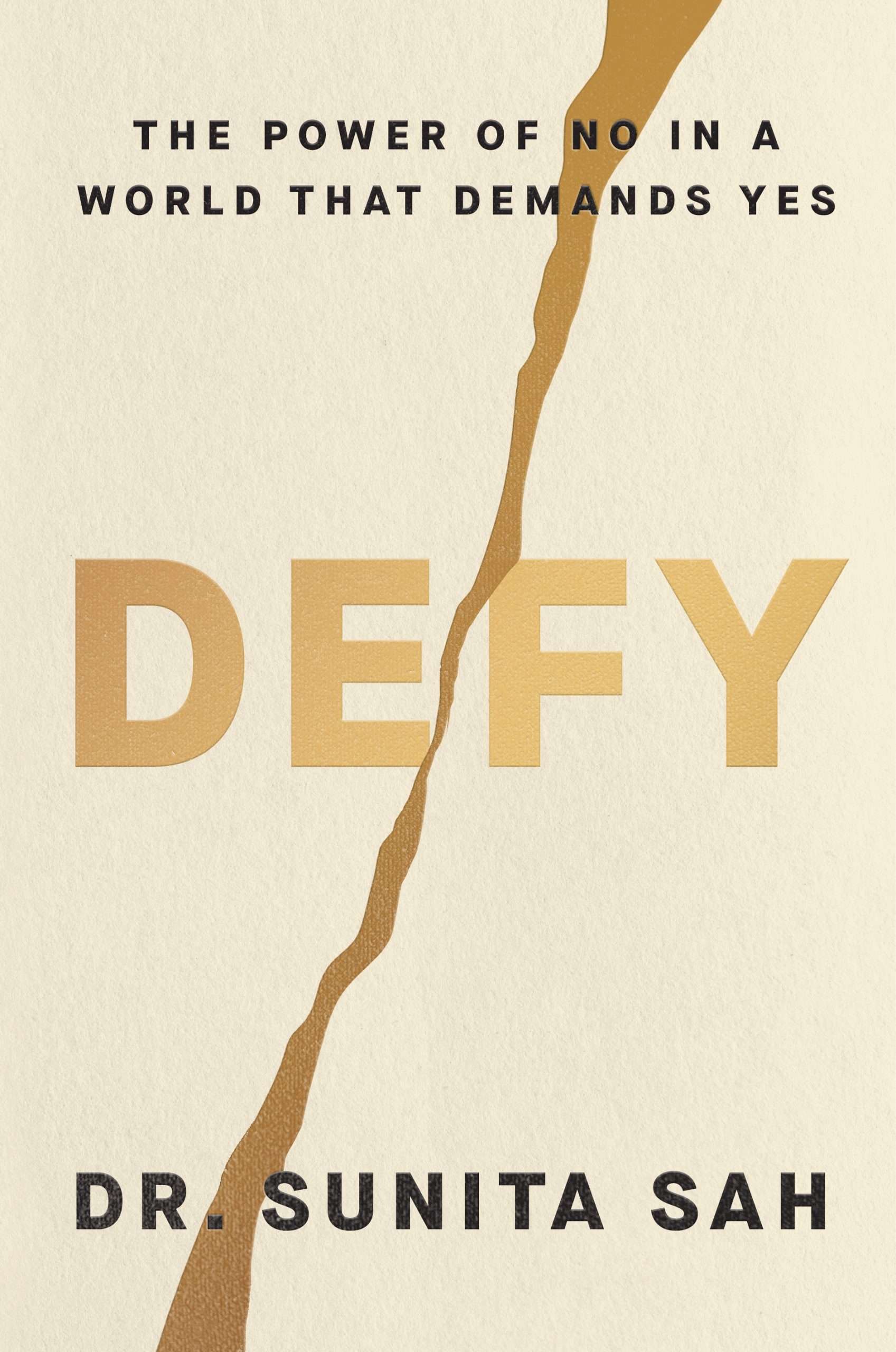
Defy: The Power of No in a World That Demands Yes
If You Keep Saying Yes When You Mean No
You know the feeling. Someone asks you for something, and before you’ve even thought about it, you’ve already agreed. Then comes the low simmer of resentment that follows you around for the rest of the day. Maybe it’s a friend who always needs a favor. Maybe it’s a partner whose needs somehow always come first. Maybe it’s the creeping sense that you’ve built an entire life around other people’s expectations and you’re not sure how to stop.
Dr. Sunita Sah, an organizational psychologist at Cornell and a former physician who’s spent her career studying why people comply even when every instinct says don’t, wrote Defy: The Power of No in a World That Demands Yes (One World, 2025) for exactly this problem. Her central argument is that defiance isn’t rebellion. It’s not slamming doors or burning bridges. She defines it as “acting in accordance with your true values when there is pressure to do otherwise.” That reframe matters, because most people who struggle with boundaries don’t see themselves as defiant. They see themselves as stuck.
What the Book Gets Right
The strongest parts of Defy are the ones that explain why saying no is so hard in the first place. Sah draws on her research into influence and authority to show how social pressure operates beneath conscious awareness. You’re not weak for going along with things you don’t want. You’re responding to deeply wired psychological mechanisms that evolved to keep you safe in groups.
That alone is worth the read. It takes the self-blame out of the equation.
She also introduces a “Defiance Compass” built around two questions: “Who am I?” and “What does someone like me do?” Simple, but it cuts through the paralysis that happens when you’re caught between what you want and what you think you’re supposed to do. For anyone working through anxiety around conflict or people-pleasing patterns in therapy, that’s the kind of thing worth bringing into session and actually practicing with your therapist.
The book is realistic about scale, too. Sah doesn’t ask you to overhaul your personality overnight. Even small acts of defiance, like saying “I need to think about that” instead of automatically agreeing, build a kind of muscle over time. That tracks with how therapy actually works. You don’t wake up one morning as a different person. You practice the uncomfortable thing in small doses until it stops being quite so uncomfortable.
Where It Falls Short
Here’s the catch. Defy is strongest when it’s talking about individual psychology and weakest when it bumps up against the messier parts of real life. Sah’s examples tend toward the professional and academic. She grew up in an immigrant family in northern England, trained as a physician, and now teaches at an Ivy League business school. Her frame of reference skews toward situations where saying no carries social cost but not, say, safety risk or financial ruin.
For people in marginalized communities, the calculus around defiance looks different. Saying no to a boss when you’re the only queer person on the team, or pushing back on a partner when you’re financially dependent, involves a kind of risk assessment that the book’s framework doesn’t always account for. That doesn’t make the book wrong. It just means you’ll need to do some translation work to apply it to situations where the stakes are higher than a workplace disagreement.
The book also leans heavily on Sah’s own story, which can make it read more like memoir than practical guide in stretches. And the five-stage framework she proposes, while useful, can feel a bit tidy for something as tangled as learning to set boundaries through a major life shift or unpacking why certain interactions trigger a freeze response.
A Solid Starting Point, Not the Whole Answer
Defy is a good book to read when you’re at the stage of recognizing the pattern but not yet sure what to do about it. Sah gives you a clear, research-backed explanation of the psychology behind people-pleasing, and some real tools to start practicing with.
But if you’re looking for something that goes deeper into the emotional roots of why you can’t say no, or that speaks more directly to the body-level anxiety and depression that often lives underneath chronic compliance, you’ll probably need more than this book alone. The Antidote is worth picking up if you want a sharper, more skeptical take on the self-help genre itself. Mind Over Mood pairs well if you want structured tools for working with the anxious thoughts that make boundary-setting feel impossible.
A therapist who gets where you’re coming from can help you figure out which tools actually fit your life, not just which ones sound good on paper. Get in touch if that’s something you’re ready for.