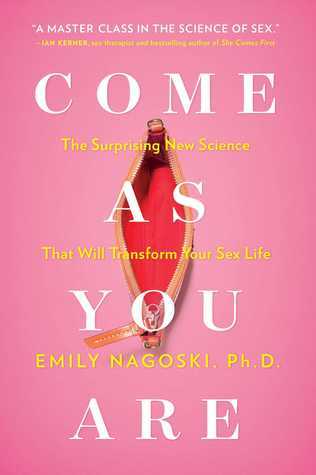
Come as You Are: The Surprising New Science that Will Transform Your Sex Life
You’re Probably Not Broken
Here’s a question that comes up constantly in sex therapy: “Why don’t I want sex the way I’m supposed to?” The assumption baked into that question is that desire should just… show up. Spontaneously. Out of nowhere. Like a craving for pizza. And if it doesn’t work that way for you, something must be wrong.
Emily Nagoski’s Come as You Are exists to dismantle that assumption, and it does a genuinely good job of it. The book lays out the science of how sexual response actually works, not how movies and magazines say it works, but what researchers have been finding for decades. The short version: there’s nothing wrong with you. The longer version takes about 400 pages, and most of them are worth your time.
The Accelerator and Brakes Model
The central framework here is the dual control model, originally developed at the Kinsey Institute. Your sexual response system has two components: an accelerator (Sexual Excitation System) that notices sexually relevant stimuli, and brakes (Sexual Inhibition System) that respond to potential threats or reasons not to be aroused right now.
Most people who think they have a “low desire” problem don’t actually have a weak accelerator. They have sensitive brakes. Stress, body image issues, relationship tension, that pile of laundry you keep meaning to deal with. All of it hits the brakes. Nagoski argues that instead of trying to rev the engine harder, you need to figure out what’s slamming the brakes and ease up on that.
It’s a genuinely useful reframe. One that tends to land hard for people who’ve spent years thinking their body is defective.
Responsive Desire Is Normal (Really)
This might be the most important chapter in the book. Nagoski distinguishes between spontaneous desire, the wanting-sex-out-of-the-blue kind, and responsive desire, where wanting kicks in only after arousal has already started. Cultural scripts treat spontaneous desire as the default and responsive desire as a dysfunction.
The research says otherwise.
Responsive desire is common, normal, and not a problem to fix. For couples dealing with mismatched desire styles, this distinction alone can shift the entire conversation from “what’s wrong with you” to “how do we create contexts where desire can show up for both of us.”
Context Is Everything
Nagoski uses a garden metaphor throughout the book: sex isn’t a drive like hunger. It’s more like a garden that needs the right conditions to grow. Same body, same person. Put them in a context where they feel safe, connected, and un-stressed, and arousal works fine. Put them in a context where they’re anxious, self-conscious, or resentful, and it doesn’t.
This sounds obvious when you say it out loud, but it runs counter to the way most people think about desire. We tend to treat it as something internal and fixed rather than something responsive to circumstances. The practical implication is that “fixing” a desire problem usually means fixing the context, not the person.
What This Looks Like in Therapy
If you’re working with a therapist on desire discrepancy, arousal concerns, or body image and sex, this book pairs well with that work. A few specific ways it shows up:
- Desire discrepancy in couples therapy: When one partner has spontaneous desire and the other has responsive desire, it’s easy for both people to feel like they’re the problem. The dual control model gives couples shared language that doesn’t pathologize either person.
- Body image and arousal: Nagoski spends real time on how cultural messages about bodies become internalized brakes on arousal. For clients doing body image work alongside sex therapy, this section tends to hit close to home.
- Stress and shutdown: The book covers the stress response cycle and how incomplete stress cycles interfere with sexual response. If you’ve noticed that stress kills your sex life but haven’t been able to figure out why “just relaxing” doesn’t fix it, this section explains the mechanism.
- Arousal nonconcordance: The gap between physical arousal and subjective experience of wanting. This concept alone has been a relief for a lot of people who’ve been confused or ashamed about their body’s responses not matching their mental state.
Where the Book Falls Short
Nagoski writes primarily about cisgender women in heterosexual relationships. She acknowledges this, but it’s still a real limitation. If you’re queer, trans, or nonbinary, you’ll probably find the core science useful while having to do some translation work around the framing and examples.
The neuroscience can be a bit pop-sci in places. She simplifies for accessibility, which is fair, but occasionally oversimplifies in ways that bug the more science-minded reader. And some sections tip into a cheerleader tone that feels more self-help than science. The “you are normal!” message is important, but by the third time it comes around, it starts to feel like she’s trying to convince herself as much as the reader.
None of this makes it a bad book. It’s a genuinely good one with some blind spots. Know what you’re getting.
About the Author
Emily Nagoski holds a PhD in Health Behavior from Indiana University, where she studied at the Kinsey Institute. She spent years as Director of Wellness Education at Smith College before writing full-time. She’s also the author of Burnout: The Secret to Unlocking the Stress Cycle (co-written with her twin sister, Amelia Nagoski), which expands on the stress response material in Come as You Are.
The 2021 revised edition includes a new preface reflecting on what she’s learned since the original publication, though the core content remains largely the same.
Further Reading
If Come as You Are resonates, a few other books on our radar go deeper on related topics:
- Sexual Intelligence by Marty Klein: Less about the mechanics of arousal and more about what “good sex” actually means when you stop measuring it by performance. A good complement to Nagoski’s work.
- Healing Sex by Staci Haines: For readers whose relationship to sex has been shaped by trauma. Somatic, body-centered approach that pairs well with the body-awareness themes in Nagoski’s work.
- She Comes First by Ian Kerner: More practical and technique-focused than Come as You Are, but shares the same basic premise that understanding your partner’s arousal matters more than any specific move.
The Bottom Line
Come as You Are is at its best when it’s giving people permission to stop pathologizing their own sexuality. The science is solid, the writing is accessible, and the core message — that context matters more than some imagined “normal” — is one that a lot of people genuinely need to hear.
If reading it brings up questions you want to work through with someone, the team at Blue Canary includes therapists who specialize in exactly this territory. You can reach out here whenever you’re ready.