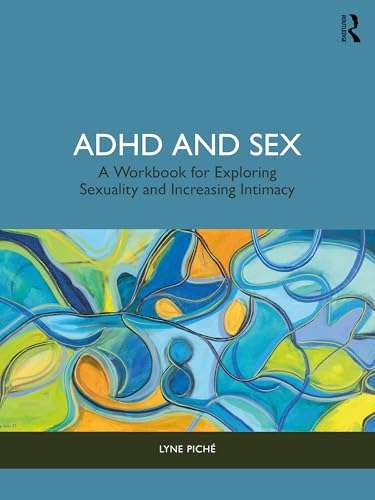
ADHD and Sex: A Workbook for Exploring Sexuality and Increasing Intimacy
If you’re in the middle of sex and you suddenly notice the radiator clicking, or the way the sheet is touching your leg, or that you forgot to respond to a text from three hours ago. And the whole thing falls apart from there. You are not broken, and you are not bad at sex. Your brain is doing what ADHD brains do. It’s just doing it at the worst possible moment.
That’s the territory ADHD and Sex: A Workbook for Exploring Sexuality and Increasing Intimacy by Dr. Lyne Piché tries to map. It came out in late 2024 from Routledge, it’s about 290 pages, and it’s structured as a workbook rather than a read-through. If the question you came here with is some version of why has sex gotten so weird since I figured out I have ADHD, this is probably the most useful book currently in print on that exact question.
Who this is actually for
A few different people end up needing this book.
The most common: someone who got an ADHD diagnosis in their twenties or thirties, started medication or therapy or both, and noticed their sex life shifted in ways nobody warned them about. Suddenly they can’t stay present during sex. Or touch they used to love feels like sandpaper. Or they realize they’ve been white-knuckling through sensory issues for years without words for any of it.
Then there’s the partner of that person. Watching someone you love seem interested in sex one week and completely checked out the next is confusing, and the usual explanations (‘they’re not attracted to me anymore,’ ‘they’re cheating,’ ‘something’s wrong with the relationship’) don’t fit. ADHD does fit, but only if someone hands you the framework.
And there’s a third group that gets less attention: couples where ADHD has slowly eroded intimacy over years. The fights about initiation. The hyperfocus phase that ended six months in. The desire discrepancy that nobody can explain. Piché treats this as a clinical problem with clinical solutions, not a sign the relationship is doomed.
What the book gets right
The central premise is the strongest part: ADHD symptoms don’t politely stop at the bedroom door. Attention dysregulation, sensory processing differences, trouble with transitions, impulsivity, emotional dysregulation: all of it shows up during sex, predictably, in ways you can name and work with. Most sex therapy books written for general audiences don’t account for any of this. Piché writes the book as if that gap is obvious and slightly absurd, which it is.

The chapter titles are honest about it too. Each one is named after a thought an ADHD person might have mid-intimacy:
- “What is that noise?”: for when ambient sound destroys your focus during sex
- “What is that feeling?”: for getting into your body when your body feels far away
- “What is going on right now?”: for the impossible task of switching from work brain to sex brain
- “I’m busy!”: for the hyperfocus problem, where you’re either all-in or completely unavailable
- “What is that smell?”: for sensory sensitivities most therapists don’t ask about
- “What have I gotten myself into?”: for impulsivity, handled without moralizing
- “Intimacy… Yikes!”: for the emotional closeness piece, which for a lot of ADHD adults is genuinely the hardest part
There’s a tool in the book called the Sexy Sexy Communication Scale, basically a 0–10 self-assessment of where you are in any given moment. It exists because partners of ADHD people keep misreading sensory overwhelm as rejection, and the scale gives you a way to say “I’m at a 3, and it’s not about you, it’s about the lighting and the day I had.” That’s a useful tool. It’s the kind of thing a couple can use on a Tuesday night.
The kink chapter is also better than expected. Piché notes, correctly and consistent with what the research on kink communities shows, that neurodivergent people are well-represented in kink spaces partly because those communities have a vocabulary for negotiating sensory needs. If you’re already kinky and ADHD, this won’t be a revelation. If you’re ADHD and kink-curious and have been wondering why the structure of it appeals to you, the book gives you some language.
What to skip or read with a grain of salt
Piché is a psychologist with 25+ years of clinical experience, but she doesn’t disclose lived ADHD experience. Some readers will feel that, and it’s fair. The book reads as clinically informed rather than written from the inside. That’s not a dealbreaker. There are good clinicians who write well about conditions they don’t personally have. But if you’re someone who reads ADHD content specifically to feel less alone, the voice here might land as competent rather than warm.
The research base is thin, and Piché admits this in Chapter 3. There just isn’t a lot of published research on ADHD and sexuality yet. Most of what’s in the book is clinical intuition and pattern recognition from her practice, which is valuable but is not the same as data. If you want the data-driven companion, that’s ADHD After Dark by Ari Tuckman, which surveyed several thousand couples and is the closest thing the field has to evidence-based numbers on this. The two books are designed to work together: Tuckman wrote the foreword to Piché’s.
The framing defaults to a couples-focused, fairly cisgender, heterosexual reader. LGBTQ+ content exists in the book but it’s not the center of the frame. For queer ADHD readers, you’ll be doing some translation. It’s worth doing — the underlying neurological material applies regardless. But it would be honest to say you’re not the first reader Piché was picturing.
One real gap: medication. There’s not much in the book about how stimulants affect libido, arousal, or orgasm, which is a question almost every newly medicated ADHD adult has. That’s a conversation to have with a prescriber, or with a sex therapist who works with neurodivergent clients regularly.
How to actually use it
Don’t read it cover to cover. It’s a workbook. Trying to read it like a memoir will exhaust you and you’ll quit on chapter four.

Pick the chapter that matches the thing happening to you right now. Attention wandering during sex, start with chapters 4 and 5. Touch and sensory overwhelm, chapter 9. Trouble transitioning from your day into sex, chapter 6. Hyperfocus phase ended and now your partner is hurt, chapter 7. Impulsive decisions you keep regretting, chapter 10. Emotional intimacy is the hardest part, chapter 11.
Do the exercises. They feel a little corny on the page, the way workbook exercises often do, but the people who get something out of this book are the ones who write in it. The people who read it like a paperback get a vague sense of being seen and then forget all of it.
If you’re working through this in neurodivergent couples therapy, or with a sex therapist who already knows the ADHD piece, the book is a great between-session resource. It gives you and your partner shared vocabulary, which is honestly half the work. The fights about sex tend to go differently when both people agree that transitions are hard for ADHD brains is a real thing and not an excuse.
Further Reading
A couple of books that pair well with this one, depending on what you need next.
ADHD After Dark by Ari Tuckman is the data-heavy counterpart. Tuckman surveyed thousands of couples where at least one partner has ADHD, and the book is full of specific numbers: frequency, satisfaction, what predicts good sex in ADHD relationships, what predicts the bad. If Piché tells you what’s happening, Tuckman tells you how common it is and what tends to help. Read both.
The Neurodiverse Couples Sex Therapy Workbook by Dr. Cheri Timko widens the lens to neurodiversity more broadly: ADHD plus autism, AuDHD, and the way those presentations show up in couples. Useful if your situation involves more than one neurotype, or if “ADHD” doesn’t fully capture what’s going on.
If you’re looking for something that puts queerness and neurodivergence in the same frame from the start, you’ll likely have better luck in the broader neurodivergence and sexuality section of the books index than in any single workbook currently in print. The book that does both well, written from the inside, hasn’t quite been written yet.