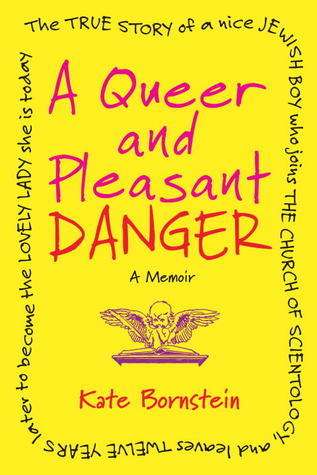
A Queer and Pleasant Danger: The True Story of a Nice Jewish Boy Who Joins the Church of Scientology and Leaves Twelve Years Later to Become the Lovely Lady She is Today
Kate Bornstein was four years old when she knew she wasn’t a boy. She spent the next several decades trying to fix that feeling, including twelve years inside the Church of Scientology, where she was drawn partly by the teaching that souls have no gender. She rose through the ranks of the Sea Organization, served on a ship with L. Ron Hubbard, got married, had a daughter, and eventually left the church, transitioned, and was declared a “suppressive person,” which meant her daughter and grandchildren were forbidden from speaking to her. This memoir is structured as a letter to that daughter. It is one of the strangest, funniest, most painful books about gender you’ll find.
The subtitle tells you what you’re in for: “The True Story of a Nice Jewish Boy Who Joins the Church of Scientology and Leaves Twelve Years Later to Become the Lovely Lady She Is Today.” Bornstein has never been interested in making her story digestible. She’s interested in telling the truth, then immediately telling you which parts of the truth she might have wrong.
Why the Scientology chapters matter more than you’d expect
About half this book is about Scientology. If you picked it up for the gender content, that might frustrate you. But Bornstein makes a case that’s hard to argue with: the same identity confusion that made her vulnerable to a high-control group is the identity confusion that eventually led her to transition. The cult didn’t cause her gender journey. It delayed it by offering a framework where gender supposedly didn’t matter, which was exactly what a person drowning in dysphoria wanted to hear.
For anyone who’s worked with clients recovering from high-control religious environments, this section of the book documents the mechanics of institutional control with rare specificity. The love-bombing, the gradual isolation, the moment when leaving means losing your family. Bornstein writes about it without bitterness, which somehow makes it worse.
Gender as something that keeps changing
Bornstein transitioned from male to female in the mid-1980s. Then she stopped calling herself a woman. She now identifies as non-binary, and the memoir captures identity as something that doesn’t arrive at a final destination. There’s no “and then I found my true self” moment. There are moments of clarity followed by new confusion followed by more clarity. The book refuses a neat arc.
That refusal is useful. Most trans-affirming clinical frameworks present transition as a process with a direction. Bornstein’s story is a reminder that for some people, gender keeps moving. Clients who feel pressure to have their identity “figured out” might find real relief in a narrative where the author, at sixty-four, still doesn’t have a tidy answer and doesn’t seem to want one.

The BDSM chapters
There are explicit sections about Bornstein’s time in a BDSM relationship in Seattle, where she served as slave to a lesbian couple. Bornstein frames this not as a detour from her gender journey but as part of it. The power exchange gave her a way to inhabit her body that nothing else had.
She includes a warning in the text so readers can skip ahead if they want. If you’re recommending this to a client, mention that. But for people in kink-aware therapy working to integrate their sexuality with the rest of their identity, these chapters are some of the most honest writing about BDSM as a site of healing rather than pathology that exists in memoir form.
What the book doesn’t pretend to be
Bornstein is white, Ashkenazi Jewish, educated at Brown, and had financial resources that many trans people don’t. She’s writing from a specific position, and while she’s aware of that, the memoir doesn’t engage deeply with how race or class intersect with gender nonconformity. If you’re looking for those perspectives, this isn’t where you’ll find them.
She also discusses self-harm and eating disorders with radical honesty but without clinical framing. The BPD diagnosis comes up early and then mostly recedes. These aren’t flaws in the book so much as limits on what one person’s memoir can do. A therapist recommending this should know the content is there, especially for clients with active self-harm histories who might need support around those sections.
And the Scientology half really does take up a lot of space. Some readers feel the gender material gets crowded out. Bornstein would probably argue that’s the point, that you can’t separate the Scientology years from the transition, that they’re the same story told from different angles.
The letter that never arrives
The whole memoir is addressed to Bornstein’s daughter Jessica, who is still inside the Church of Scientology and cannot, by the rules of the organization, read this book or speak to her parent. The epilogue is called “Hello, Sweetie.” It is devastating in a quiet way.
For clients processing family estrangement, whether from religious communities, from families who rejected their queerness, or from any circumstance where the people you love are unreachable, this frame gives the whole book a different weight. Bornstein isn’t writing to convince the world. She’s writing to one person who will probably never read it.

Who should read this
Anyone working through gender identity who feels their story is too complicated for the standard narratives. Anyone recovering from a high-control religious group. Anyone in the kink community who wants to see BDSM discussed as something other than a disorder. Anyone estranged from family and trying to figure out what to do with the love that has nowhere to go.
If Bornstein’s voice connects for you, her earlier Gender Outlaw is the theoretical companion to this memoir, and My Gender Workbook turns those ideas into something you can actually do exercises with. Both are in our collection.