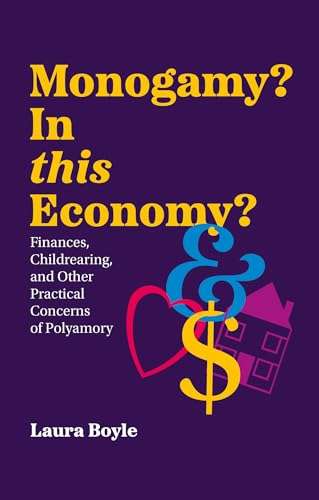
Monogamy? In this Economy?: Finances, Childrearing, and Other Practical Concerns of Polyamory
A lot of the conflict that polyamorous folks bring to therapy sounds emotional on the surface. “My partner doesn’t respect my needs.” “I feel invisible in this relationship.” But when you dig in, there’s often a logistical problem underneath that nobody’s solved. Unequal financial contributions. Unclear expectations about shared space. Parenting decisions being made without everyone’s input.
Most polyamory books don’t touch this. They’re focused on jealousy, communication, attachment, the emotional architecture. Which matters. But if three adults share a two-bedroom and nobody’s talked about the bathroom schedule, all the communication skills in the world won’t keep the resentment from building.
What This Book Does That Others Don’t
Laura Boyle’s Monogamy? In this Economy? goes after the part nobody else is writing about: money, housing, kids, chores, custody agreements. The boring-but-essential reality of actually building a life with multiple partners. Boyle runs Ready for Polyamory and has spent years coaching people through exactly these situations. She interviewed over four hundred people in every polyamorous configuration you can imagine: triads sharing a house, polycules across multiple apartments, nesting partners plus satellite relationships, blended families with kids from various combinations.
The result reads less like a relationship book and more like a really specific guide to communal living. The New York Times included it in their 2024 roundup of non-monogamy books, which is a decent signal this isn’t just another poly 101.
The “Roommate First” Idea
One of Boyle’s central concepts: treat your partners and metamours like roommates first. Sounds almost too simple. But here’s why it works. Most domestic conflict between partners gets tangled up in emotional weight. You’re not just annoyed that they didn’t do dishes; you’re feeling unvalued, unseen, whatever the deeper thing is.
Boyle’s suggestion is to separate the logistical problem from the relationship problem. If a roommate left dishes in the sink, you’d just say “hey, can you do your dishes?” without spiraling into what it means about your connection. Same principle applies when you’re sharing space with a partner or metamour.
It won’t fix everything. But it takes the temperature down on a lot of fights that aren’t really about the dishes.
The Logistics It Covers
- Housing: Who lives where? How do you handle a shared mortgage when there’s no legal framework for three people on a deed? What do you tell the landlord?
- Money: Joint accounts versus separate ones, splitting expenses, income disparities between partners. What happens financially when someone new moves in or a relationship ends?
- Kids: Custody arrangements, parenting roles for non-biological parents, school conversations, dealing with ex-spouses who aren’t on board with the structure.
- Space and privacy: Bedrooms, noise, bathroom schedules. Trivial until they’re not.
- Breakups: The practical fallout when a relationship ends and you share a lease, a kid, or a mortgage. Nobody talks about this enough.
The four hundred interviews mean Boyle has seen more configurations and more failure modes than most people in this space. That breadth shows up in the advice, which rarely assumes you’re in one particular kind of arrangement.
What It Covers Well and What It Doesn’t
The biggest strength is how specific and practical it is. If you’re already living in a poly configuration and running into logistical friction, this book meets you where you are. No abstract theory. No “every relationship is different so figure it out yourself.” Actual frameworks you can try this week.
The book leans heavily toward a specific kind of polyamory, though: established, cohabiting, often with kids. If your version of non-monogamy is more independent and less domestic (you live alone and have partners you don’t plan to combine households with), a lot of this won’t apply.
The legal sections are also limited by geography. Housing law, custody precedent, financial instruments vary wildly by state and country. Boyle acknowledges this, but if you’re looking for specific legal guidance in New York, you’ll still need a poly-friendly attorney.
And the book doesn’t get into emotional processing. That’s by design. But if reading about finances and custody stirs up unresolved relationship dynamics, you might need to work through some of that before the practical pieces can land. If you’re newly curious about polyamory and still figuring out the basics, start with The Ethical Slut or Polysecure first.
Reading This Alongside Therapy
This book works particularly well as something to bring into sessions. If you’re working with a therapist who understands polyamorous relationships, the specific chapters (housing, finances, parenting) give you a concrete framework for conversations that otherwise tend to spiral. It’s easier to talk about money and space when you have a shared reference point rather than starting from scratch every time.
Not every framework in the book works for every setup. A triad sharing a house has different problems than a V with separate apartments. A good therapist can help you sort through what actually applies to your configuration and what to set aside.
Other Books in This Space
For the emotional side of non-monogamy, pair this with Polysecure for attachment and security in poly relationships, or The Smart Girl’s Guide to Polyamory for a broader overview. Building Open Relationships covers some similar ground with more focus on relational dynamics. And The Jealousy Workbook is the go-to if jealousy is the specific thing getting in the way.