

You’re Not Broken — You’re Just Made of Parts: Internal Family Systems
You’re in your kitchen. A glass slips and shatters on the floor. Instantly, voices flood your mind: “Damn, why did that happen to me?” “You’re so dumb for letting that happen.” “My partner’s going to be mad. I’m in trouble.”
If you’ve ever had a moment like that — full of mental noise, blame, and anxiety — you’re not alone.
But maybe, underneath it all, there’s a quieter voice whispering: “None of this really matters. It’s going to be okay.”
That moment is a perfect glimpse into what we explore in Internal Family Systems (IFS) — a powerful, compassionate therapy model that helps us make sense of the different “parts” inside us. Those voices? They’re not random. In IFS, they’re called parts, and each one has a story.
What is IFS you ask?
IFS was developed in the 1980s by Dr. Richard Schwartz, a family therapist who noticed his clients often described inner “subpersonalities” — different parts of themselves that felt, acted, or believed in conflicting ways. Instead of seeing that as pathology, he got curious. And from that curiosity, IFS was born.
That idea — that we contain multitudes — is actually quite old. It shows up in indigenous healing traditions, mindfulness practices, and spiritual teachings from all over the world. As a model, IFS gives us a structured, supportive way to work with that inner complexity.
If you’re interested in diving deeper into the roots of IFS or hearing stories from real people, check out: No Bad Parts by Richard Schwartz or The One Inside Podcast , hosted by Tammy Sollenberger.
You’re Not Just One “You”
At the heart of IFS is this beautifully simple truth: You are not a single, unified personality. You’re a system of parts — each with its own emotions, beliefs, and protective strategies.
Some parts are loud and critical. Some avoid or shut down. Some numb you out. And some are incredibly tender and vulnerable. They may conflict, but they’re all trying to help in the only way they know how.
Your Parts Aren’t Flaws
This is one of the most healing things about IFS: your parts aren’t the problem. Even the ones that feel “too much,” or “too loud,” or “too anxious” — they’re doing their best to protect you.
Most parts are shaped by past experiences. They’re still carrying old pain, unmet needs, or roles they took on early in life. IFS helps you meet them with curiosity, not judgment — and that’s where healing begins.
The Three Main Types of Parts
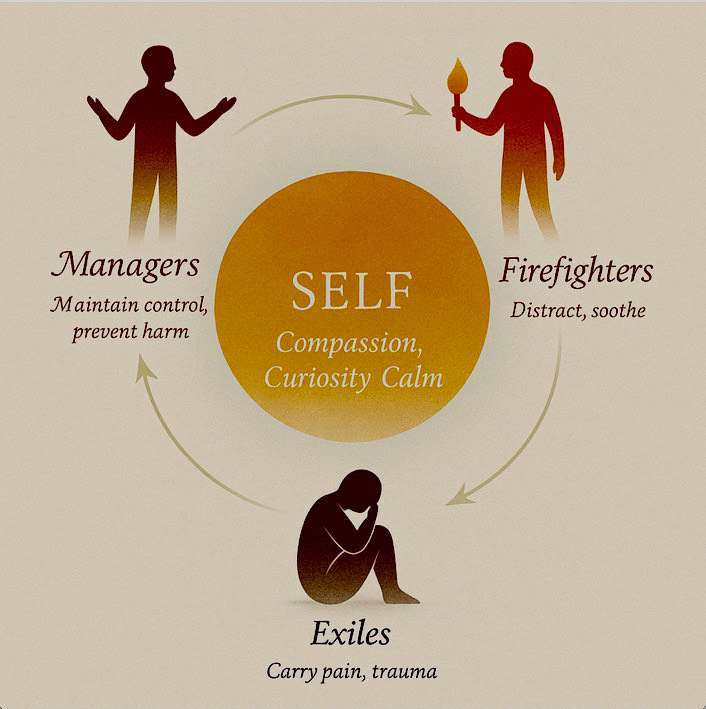
IFS organizes parts into three general categories:
- Managers: These types of parts run the show. They plan, perfect, control, perform — all to help you avoid emotional pain.
- Firefighters: When pain breaks through, Firefighters react fast. They try to numb or distract you — with food, work, screens, substances, or shutting down.
- Exiles: These are your most tender parts. They carry old wounds — fear, shame, grief. Managers and Firefighters work hard to keep them hidden, but they’re the ones who most need your care.
At the center of it all: The Self. Beneath all your parts is your Self — your calm, compassionate, grounded core. In IFS, the Self isn’t a part. It’s you beneath it all — the one who’s curious, caring, and connected.
When your Self is leading, your parts don’t have to work so hard. They can relax. And that shift — from being parts-led to being Self-led — is what creates real change.
Want to see how IFS works? Check out this intro video from the IFS Institute.
What Can IFS Help With?
IFS can be helpful for:
- trauma
- anxiety
- depression
- addiction
- burnout
- relationship patterns
- emotional reactivity.
And you don’t have to be in crisis to benefit. IFS is also a tool for self-awareness, clarity, and personal growth. If you’re into the research side of things, here’s a 2020 study on IFS and PTSD.
What Does an IFS Session Look Like?
It often starts with tuning into a part that’s been active. Maybe it’s the one that gets anxious at night, or the one that panics when your phone buzzes. With a therapist’s help, you pause, get curious, and listen to the part — without judgment.
Over time, you begin to hear what that part’s been protecting… and what it actually needs. There are several podcasts and YouTube videos that can give you examples of IFS sessions. If you’re interested in diving deeper into the roots of IFS or hearing stories from people, check out: IFS Talks by Anibal Henriques, Tisha Shull, and Alexia Rothman or The One Inside Podcast , hosted by Tammy Sollenberger. To watch a live IFS session with Richard Swartz, you can go here, to get a sense of what it would look like.
You Can Start Right Now
One of the most beautiful things about IFS? You don’t have to wait for therapy to begin. The next time you feel triggered, ask yourself: “Who inside me is feeling this way?”
Then listen. Maybe write it down. Let your parts speak. No fixing. No pushing. Just noticing — with compassion. That’s already a step toward healing.
You’re Not Broken — You’re Just Made of Parts
All those voices inside? They’re parts, each doing their best to help you. IFS invites you to lead your life from your Self — the grounded, loving core of who you are.
And when the Self leads? Everything begins to change.
Ready to explore this work with a therapist?
Reach out to us at Blue Canary Therapy to connect with an IFS-informed therapist who can walk with you on this journey.

Frankie Janiec
I'm a queer therapist providing trauma-informed, queer and trans-affirming care through a holistic approach that integrates Internal Family Systems, mindfulness, and somatic practices to foster self-compassion and clarity. My specialties include LGBTQIA+ identity, gender exploration, nontraditional relationships, psychedelic integration, C-PTSD, and Hallucinogen Perception Persistent Disorder.