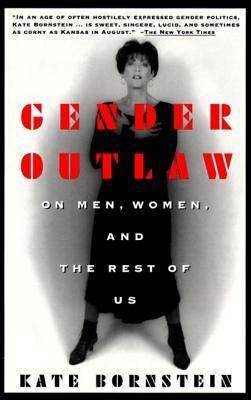
Gender Outlaw: On Men, Women and the Rest of Us
Kate Bornstein didn’t write Gender Outlaw: On Men, Women and the Rest of Us to make anyone comfortable. When it was first published in 1994, Bornstein — a trans woman, performance artist, and self-described gender outlaw — was asking questions that most of the mainstream wasn’t ready for. What if gender isn’t something you are, but something you do? What if the categories themselves are the problem? Three decades later, the questions still land.
Bornstein’s path to writing this book wound through some unexpected territory. She spent twelve years in the Church of Scientology before leaving, transitioning, and eventually building a career as a writer and performer who uses her own life as raw material. The book reflects that range. It’s part autobiography, part cultural criticism, part theater, and part dare.
The Rules Nobody Agreed To
The central argument is deceptively simple: gender is a system, not a fact. Bornstein distinguishes between sex (biology) and gender (a set of cultural rules we’re expected to follow), and then spends the rest of the book poking holes in the idea that either one is as fixed as we’ve been told.
What makes this more than an academic exercise is that Bornstein writes from inside the experience. She’s not theorizing about gender from a safe distance. She’s describing what it feels like to live outside the binary, to be told you don’t exist in the terms available, and to decide that the terms need to change. The writing is funny, sharp, and deliberately messy. There are scripts from her plays woven in. There are questions she doesn’t answer. It reads less like a manifesto and more like a mind working things out in real time.
Why It Still Matters
A lot has changed since 1994. Language around gender has expanded enormously. Non-binary identities have more visibility. Trans rights are in the news constantly, even if the coverage is often terrible. You might wonder whether a book this old still has something to offer.
It does, but not necessarily for the reasons you’d expect. Gender Outlaw isn’t a 101 guide. It’s not going to define terms for you or walk you through coming out. What it does is something harder to find: it gives you permission to not have it figured out. Bornstein’s whole project is about questioning, not arriving. For people who feel stuck between categories, or who’ve been told their experience of gender doesn’t make sense, that permission is its own kind of relief.
The book also provides historical context that’s easy to lose when the conversation about gender feels like it started on social media. Bornstein was doing this work before most current frameworks existed. Reading her is a reminder that people have been living outside the binary for a very long time.
Reading This as a Therapy Client
If you’re working with a therapist on questions about gender identity, this book can serve a different function than the more clinical resources. It’s not going to give you a diagnosis or a roadmap. But it might help you feel less alone in the questioning, which is often the harder part.
For people who are exploring gender in the context of trans-affirming therapy, Bornstein’s refusal to pin things down can actually be freeing. A lot of the pressure around gender identity comes from the expectation that you should know exactly what you are and be able to explain it clearly. This book pushes back on that expectation directly.
It’s also a useful read for partners, family members, and friends who want to understand without being given a script. Bornstein’s humor and honesty make the material accessible even when the ideas are challenging. And if questions about gender intersect with other parts of your identity — sexuality, relationships, the communities you belong to — queer-affirming therapy can help you sort through the overlap.
A Few Caveats, and Where to Go From Here
Some of the language is dated. Bornstein uses terms and framings that have shifted significantly since the ’90s, and readers coming to this fresh might stumble over phrasing that was progressive then but reads differently now. The revised edition (2016) updates some of this, but not all of it.
The book is also deliberately non-linear and performative. If you want straightforward information, this isn’t where to start. If you want something that makes you think sideways about things you assumed were settled, it’s exactly right. Bornstein’s companion workbook, My Gender Workbook, offers a more interactive and hands-on approach to the same ideas. And if you’re looking for something that brings the conversation into the present, Pageboy by Elliot Page is a good companion read. Reach out if you want to talk any of this through with someone who gets it.