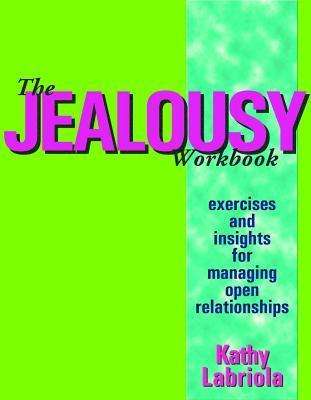
The Jealousy Workbook: Exercises and Insights for Managing Open Relationships
Jealousy Hits Different When You Chose This
Jealousy in open relationships carries a specific kind of weight. In monogamous relationships, jealousy usually points to a boundary being crossed. But when you’ve actively chosen non-monogamy, jealousy can feel like proof that you’re doing it wrong, that you’re not built for this, or that something in you is broken.
It’s not.
Kathy Labriola, a counselor and nurse based in Berkeley who has worked with polyamorous clients for over three decades, wrote The Jealousy Workbook: Exercises and Insights for Managing Open Relationships (Greenery Press, 2013) specifically to address that gap. She’s been polyamorous herself for decades and brings both clinical experience and lived understanding to a topic most relationship books either skip entirely or handle with a few paragraphs of vague reassurance.
What the Book Actually Does
The Jealousy Workbook is structured around forty-two exercises, and it really does function as a workbook. You’re not just reading about jealousy in the abstract. You’re identifying your specific triggers, mapping out what jealousy actually feels like in your body, and building concrete strategies for the moments when everything feels like too much.
One of the strongest exercises is what Labriola calls the “fear inventory.” It asks you to get granular about what you’re actually afraid of. Not “I’m jealous” but “I’m afraid my partner will realize they like spending time with their other partner more than with me.” That kind of specificity matters. Vague dread is almost impossible to work with, but a concrete fear is something you can actually examine and talk about.
The book also distinguishes between different types of jealousy, which is more useful than it might sound. There’s a real difference between “I feel left out” and “I feel replaced” and “I feel like the agreements we made aren’t being honored.” Labriola helps readers sort through those distinctions so they can figure out what they actually need, rather than just reacting to a wall of bad feelings.
Where It Works Best
This book is at its strongest as a crisis tool. If you’re in the middle of a jealousy spiral and need something practical to do right now, several of the exercises are designed for exactly that. They’re short, concrete, and don’t require your partner to be in the room. That matters, because jealousy often hits hardest when you’re alone, and the last thing you need in that moment is a technique that requires a two-hour processing conversation.
It’s also genuinely useful for people who are newer to polyamory and non-monogamy. If you’re opening up a previously monogamous relationship or you’re in your first poly relationship and getting blindsided by feelings you didn’t expect, the workbook format gives you something tangible to hold onto while you’re figuring things out.
Where It Shows Its Age
The Jealousy Workbook was published in 2013, and some of the framework reflects the polyamory discourse of that era. The book leans heavily toward hierarchical relationship structures, with a lot of the exercises assuming a primary/secondary model. If you practice relationship anarchy, solo polyamory, or any non-hierarchical structure, you’ll find yourself mentally translating a good portion of the material.
More significantly, some readers have pointed out that the book occasionally frames jealousy management as something that happens through limiting a partner’s other relationships. Asking a partner to text less with their other partner, or to slow down a new relationship, can sometimes be a reasonable temporary measure. But as a default strategy, it shifts the emotional work onto someone else’s connection rather than sitting with your own discomfort. Worth knowing going in.
The book also doesn’t do much to address the experiences of queer and trans folks in non-monogamous relationships, or people who are asexual or aromantic. Jealousy doesn’t look the same across all of those experiences, and a workbook that treats it as one-size-fits-all misses some of the texture.
Jealousy as Information, Not Failure
One of the better ideas running through the book is that jealousy isn’t a character flaw. It’s data. It tells you something about your attachment patterns, your unmet needs, your fears about loss or inadequacy.
That reframe alone can be a real relief if you’ve been beating yourself up for feeling jealous in a relationship structure you actively chose.
If you’re already working with a therapist on anxiety or relationship patterns, this workbook can pair well with that process. The exercises give you material to bring into sessions, and a therapist can help you go deeper into the patterns the workbook surfaces. Jealousy in couples therapy often has layers that a self-help book can identify but not fully untangle on its own.
Who This Is For (and Who Should Look Elsewhere)
This is a solid pick if you’re in a hierarchical poly relationship, you’re newer to non-monogamy, or you’re someone who processes things better through writing and structured exercises than through reading theory. It’s practical, it’s accessible, and it doesn’t require you to already have a PhD in attachment theory to get something out of it.
If you’re looking for something with more depth on attachment and trauma in non-monogamous relationships, Polysecure by Jessica Fern goes further into that territory. For a broader look at the nuts and bolts of open relationships beyond jealousy, Opening Up by Tristan Taormino and The Ethical Slut by Hardy and Easton cover more ground. And if you want a resource that takes a less hierarchy-centered approach to polyamory, Polywise might be a better fit.
The Jealousy Workbook won’t fix jealousy. Nothing will, because jealousy isn’t a malfunction. But it can give you better tools for understanding what’s happening when it shows up, and that’s worth something.