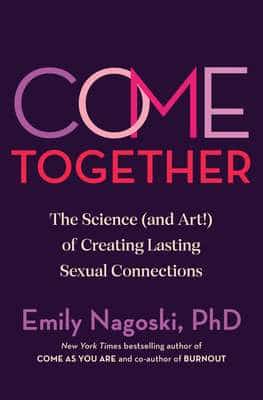
Come Together: The Science (and Art!) of Creating Lasting Sexual Connections
Here’s the thing about sex in long-term relationships: it doesn’t work the way we’ve been told. We’ve all absorbed this idea that desire should be spontaneous – that if you’re really attracted to someone, you should just want them, all the time, forever. And when that fades (which it does, for most people), we assume something’s broken.
Emily Nagoski’s Come Together turns that whole narrative on its head. This isn’t a book about rekindling the spark or learning new techniques. It’s about understanding how sexual connection actually works – and honestly, it changes everything.
What This Book Is Really About
Nagoski’s central argument is deceptively simple: pleasure matters more than desire. Instead of worrying about how often you want sex, focus on how much you enjoy the sex you’re having. It sounds obvious when you put it that way, but for a lot of couples stuck in the “why don’t you want me anymore?” spiral, this reframe is genuinely revolutionary.
The book is grounded in research but written for real people. Nagoski – who’s a sex educator with a PhD – has this way of making neuroscience feel accessible without dumbing it down. She explains how our brains have both “accelerators” (things that turn us on) and “brakes” (things that shut us down), and how understanding your personal patterns can transform your approach to intimacy.
The Emotional Floor Plan
One of the more useful frameworks in the book is what Nagoski calls the “emotional floor plan” – basically a map of your internal states that either support or block pleasure. Some people find metaphors like this a bit gimmicky, and that’s fair. But there’s something to be said for having a concrete way to talk about what’s going on inside you.
The idea is that you can learn to recognize which “rooms” you’re in – stress, disconnection, shame – and what helps you move toward the rooms where pleasure becomes possible. It’s not magic, and Nagoski doesn’t pretend it is. But it gives couples a shared language, which is half the battle.
In our couples therapy work, we see this pattern constantly: partners who love each other, find each other attractive, and still struggle with sexual connection. Usually the issue isn’t desire – it’s context. Stress, unresolved conflict, feeling unseen. Nagoski’s framework helps name what’s actually going on.
Breaking Free from Gender Scripts
This is where the book gets a bit more political, and some readers might find it uncomfortable. Nagoski argues that a lot of our sexual struggles come from gender socialization – the messages we absorbed growing up about what sex means, who initiates, who receives, who’s responsible for whose pleasure.
She identifies two common patterns: the “Winner” script (often assigned to boys) and the “Giver” script (often assigned to girls). These early messages create friction in adult relationships, and until you see them clearly, they keep running the show.
The thing is – this analysis isn’t just for heterosexual couples. We see these same patterns playing out in queer relationships, where partners have often internalized conflicting scripts, or rejected them entirely and are trying to figure out what to replace them with.
What Makes This Different from Other Sex Books
Let’s be real – there are a lot of sex and relationship books out there. What sets Come Together apart is its commitment to being genuinely inclusive. Nagoski explicitly discusses LGBTQ+ couples, polyamorous relationships, and kink dynamics. These aren’t afterthoughts or token mentions – they’re woven throughout the book.
For our clients in polyamory therapy and kink-friendly therapy, this matters. Most mainstream sex advice assumes a monogamous, heterosexual framework. Nagoski doesn’t.
She also draws on therapeutic frameworks that many therapists actively use – Emotionally Focused Therapy (EFT) and Internal Family Systems (IFS). If you’re already working with a therapist, you might recognize some of the concepts. The book extends these ideas specifically into the realm of sexual connection.
What You’ll Actually Learn
Here’s the practical stuff:
- How to identify your accelerators and brakes – what turns your brain on and off, specifically
- Why context matters so much – and how to create conditions where pleasure becomes possible
- The difference between responsive and spontaneous desire – and why neither is “better”
- How to talk about sex without it feeling like a performance review – communication strategies that actually work
- How to work with shame – rather than pretending it doesn’t exist
Each chapter includes a TL;DR summary and reflection questions, which makes it easier to process if you’re working through it with a partner or bringing it to therapy.
Some Things Worth Knowing
No book is perfect, and Come Together has its quirks. Nagoski’s writing style is warm and casual – she’s got a millennial-influenced tone that some readers find engaging and others find distracting. There’s a fair amount of self-help language toward the end that can feel a bit generic.
More substantially, the book sometimes leans into an individualistic view of relationship challenges. Systemic barriers – how class, race, disability, and other factors affect intimate connection – get mentioned but not deeply explored. If you’re looking for analysis of how oppression shapes sexuality, you’ll need to supplement with other reading.
That said, for what it sets out to do – help couples understand and improve their sexual connection – it does the job well.
Using This Book in Therapy
We recommend Come Together to clients all the time, but with a caveat: it works best as a complement to therapy, not a replacement for it. Reading about the accelerator/brake model is one thing. Actually doing the work of understanding your specific patterns, communicating with your partner, and sitting with the emotions that come up – that’s where sex therapy comes in.
Some ways clients use this book:
- As shared reading with a partner – working through chapters together and discussing
- As homework between sessions – bringing insights or stuck points to therapy
- As a starting point for couples who aren’t sure if sex therapy is right for them – it can help clarify what you actually need
If something in the book resonates but you’re not sure what to do with it, that’s exactly what therapy is for. The frameworks Nagoski offers are useful, but frameworks only take you so far. At some point, you need someone in your corner who can help you apply them to your actual life.
For Polyamorous and Non-Monogamous Readers
A lot of sex and intimacy books assume monogamy, which can make them frustrating for ENM folks. Come Together is better than most on this front – Nagoski explicitly includes polyamorous relationships in her examples and doesn’t treat monogamy as the default.
That said, there are some gaps. The book focuses primarily on dyadic (two-person) connection, so if you’re in a triad or other multi-partner dynamic, you’ll need to do some translation. And some of the advice about prioritizing “the relationship” gets complicated when you have multiple relationships to prioritize.
For clients in our polyamory practice, we often recommend pairing this with Polysecure or Polywise, which tackle the specific attachment and communication challenges of non-monogamy more directly.
Related Resources
If Come Together resonates, you might also find these useful:
- Come as You Are by Emily Nagoski – her earlier book focused on women’s sexuality specifically
- Mating in Captivity by Esther Perel – explores desire and eroticism in long-term relationships from a different angle
- Hold Me Tight by Sue Johnson – the foundational book on Emotionally Focused Therapy for couples
- The Body Keeps the Score by Bessel van der Kolk – if trauma is part of your story, this helps understand how it affects intimacy
Ready to Work on Sexual Connection?
Look, books are great. They can give you frameworks, language, new perspectives. But reading about sexual connection and actually building it are different things. If you’re recognizing yourself in what Nagoski describes – the brakes that won’t release, the desire patterns that don’t match, the conversations you keep avoiding – that’s information worth doing something with.
Our sex therapists work with couples and individuals on exactly these issues. Many of our therapists have specialized training in sex therapy and bring lived experience in LGBTQ+, poly, and kink communities. We’re not here to tell you what your sex life should look like – we’re here to help you figure out what you actually want and how to get there.
Ready to take the next step? Schedule a free consultation with one of our therapists.